Categories
News Project Safe Havens Safe Residencies

Nurperi Orunbaeva: Decolonising the Self through Artistic Practice and Reimagining Ancestral Heritage

Nurperi Orunbaeva: Decolonising the Self through Artistic Practice and Reimagining Ancestral Heritage

September 18, 2025

Written by Aliona Pazdniakova

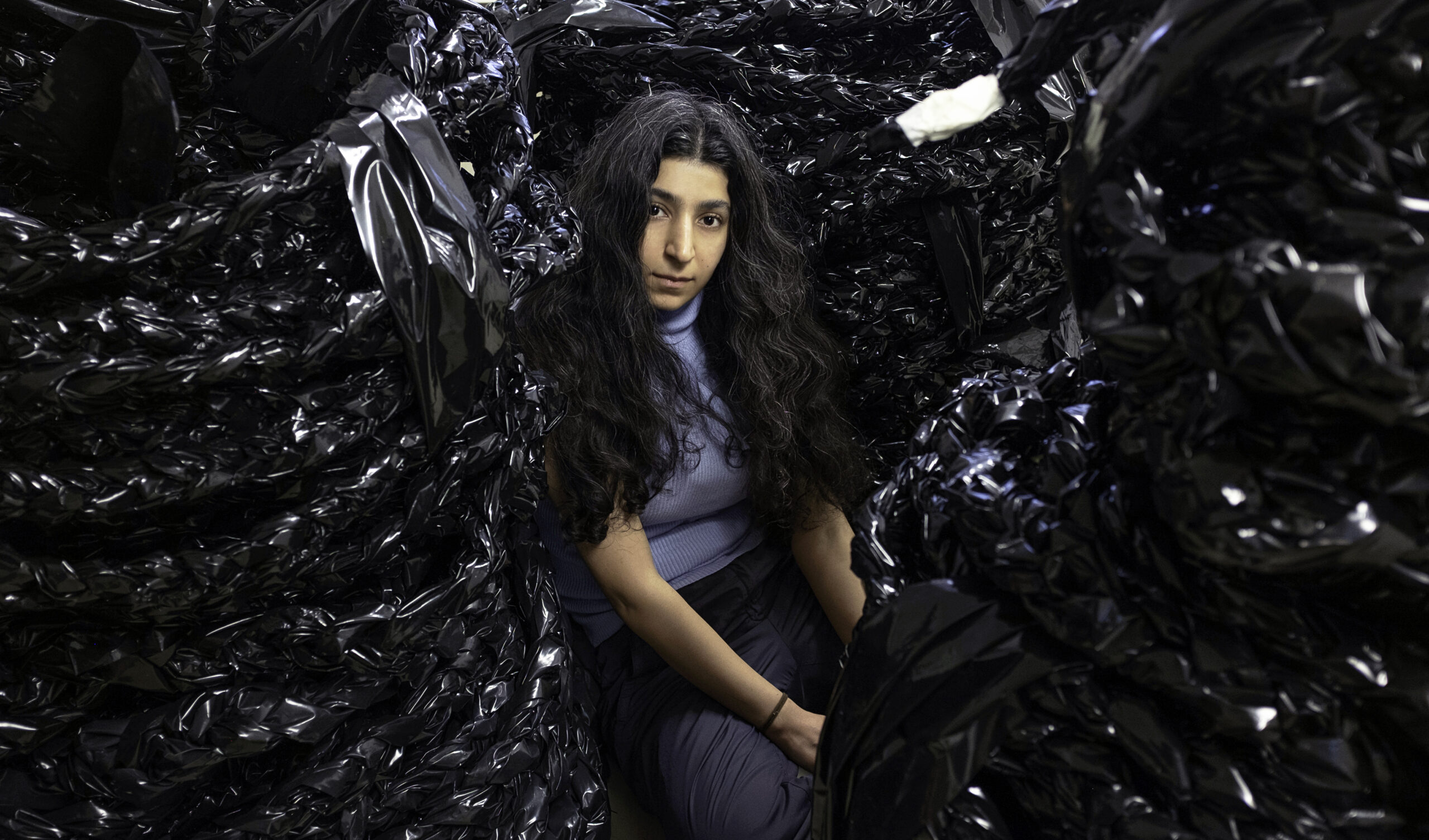
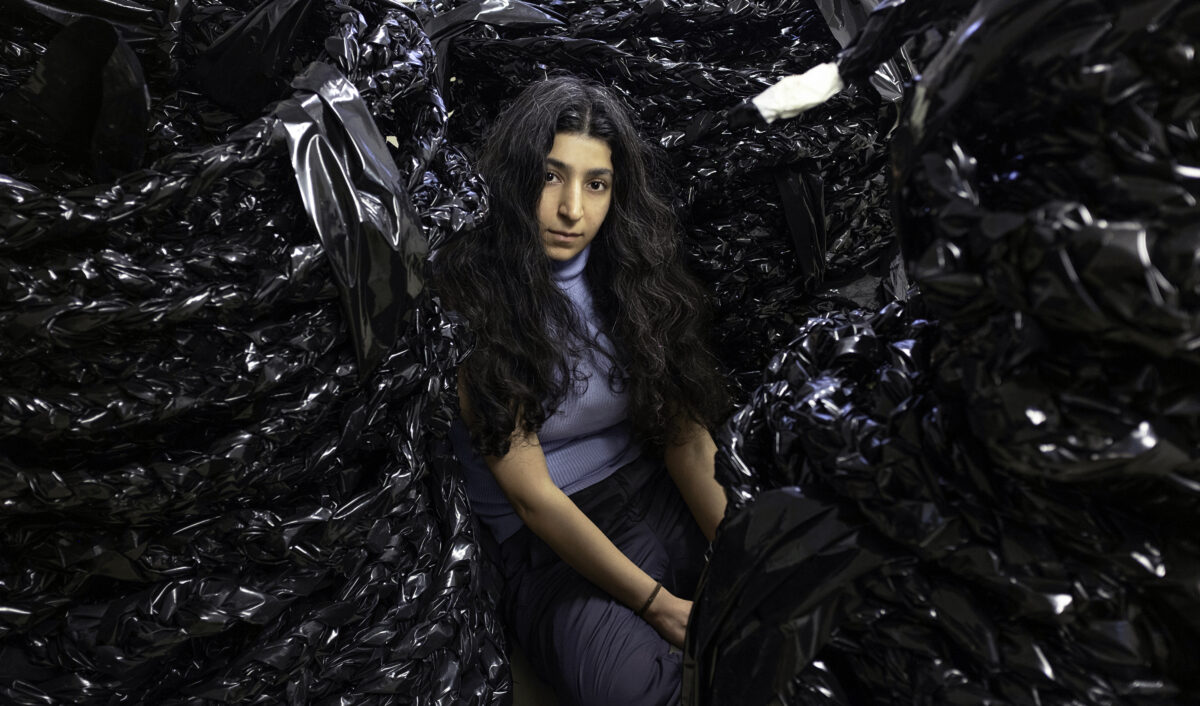
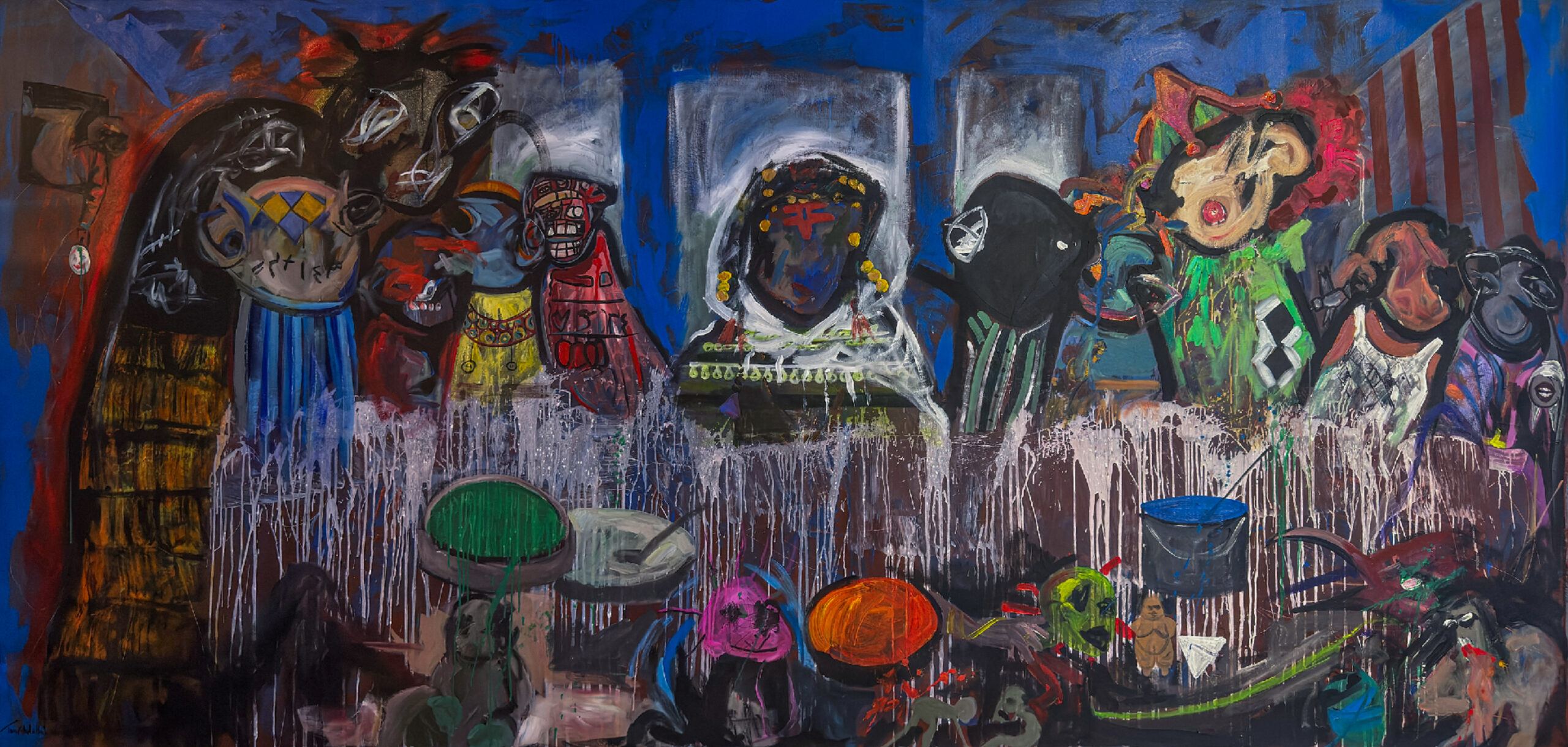
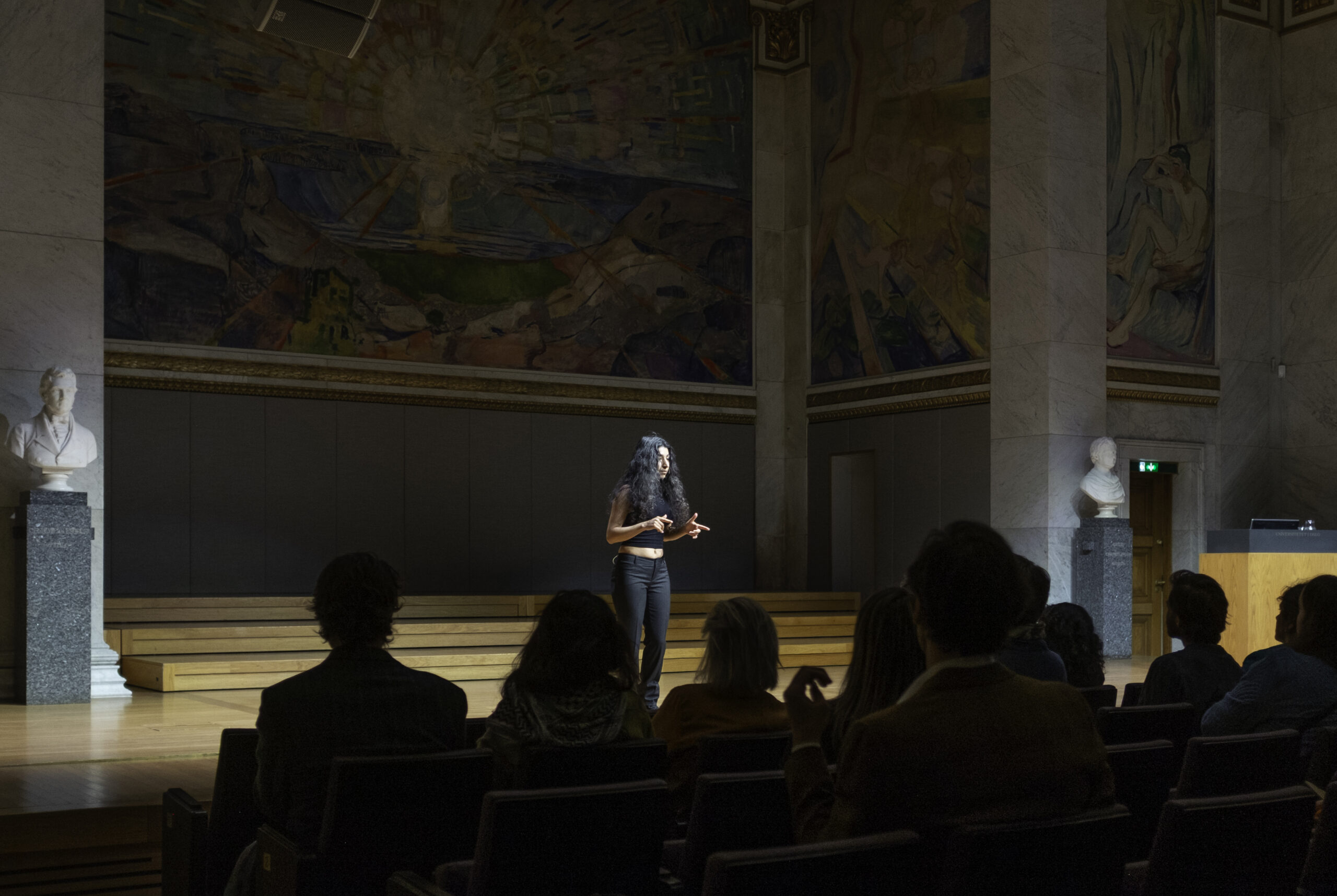
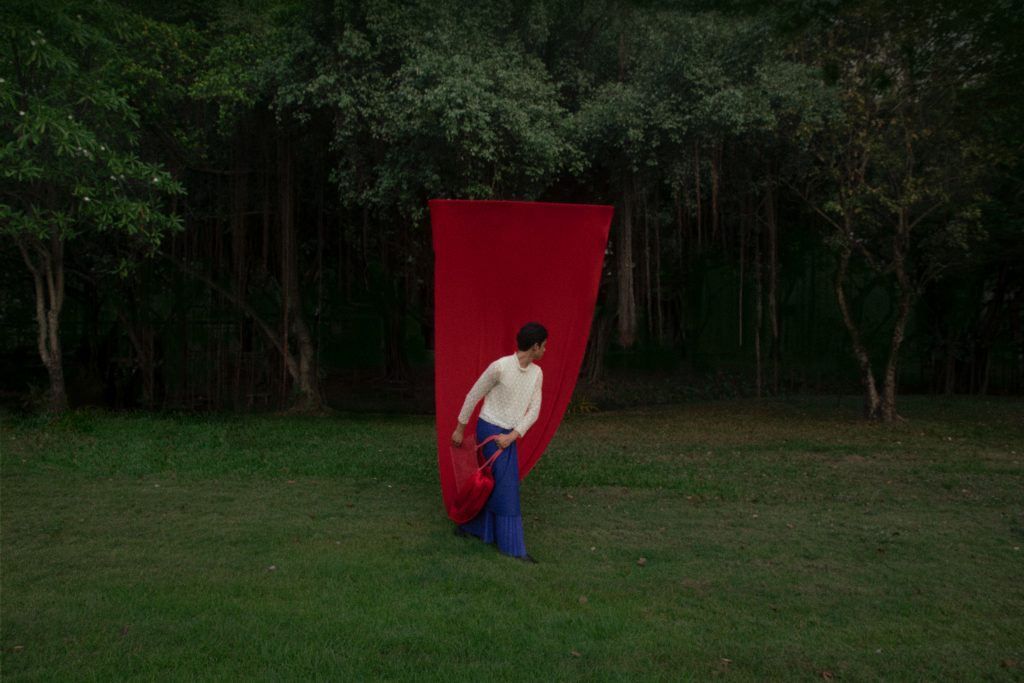
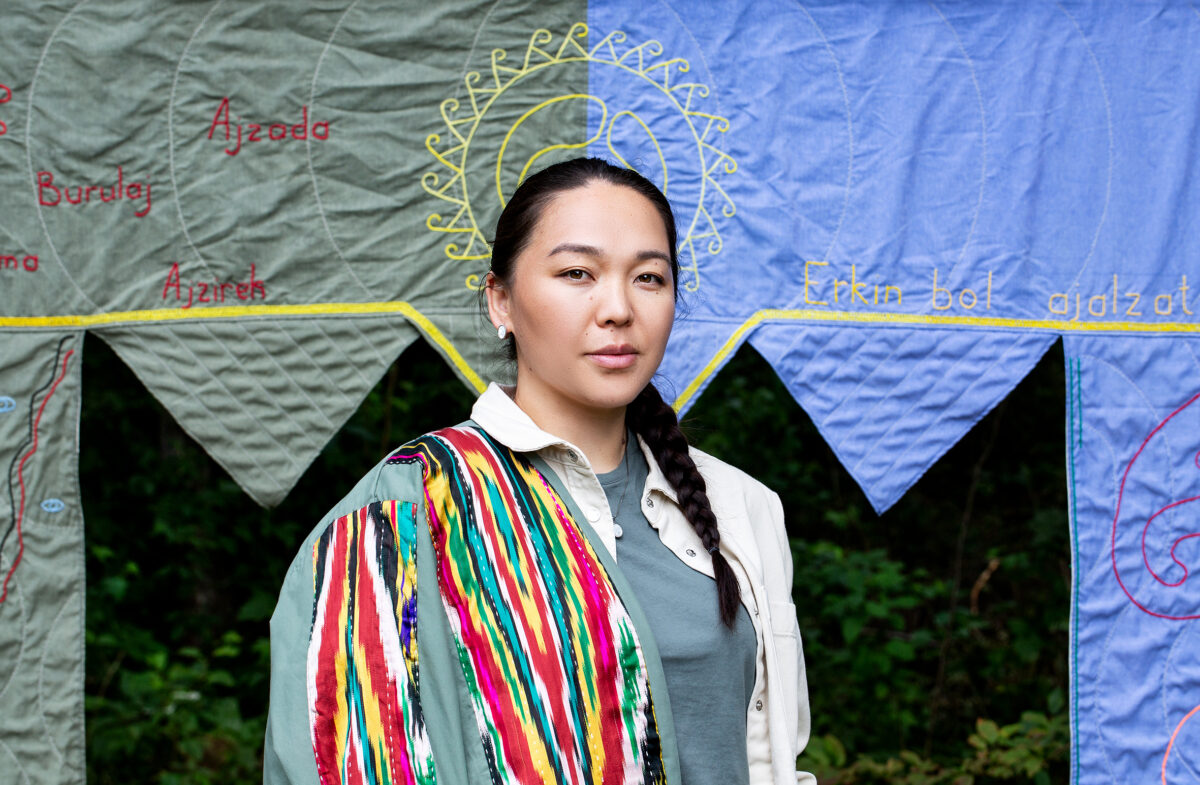
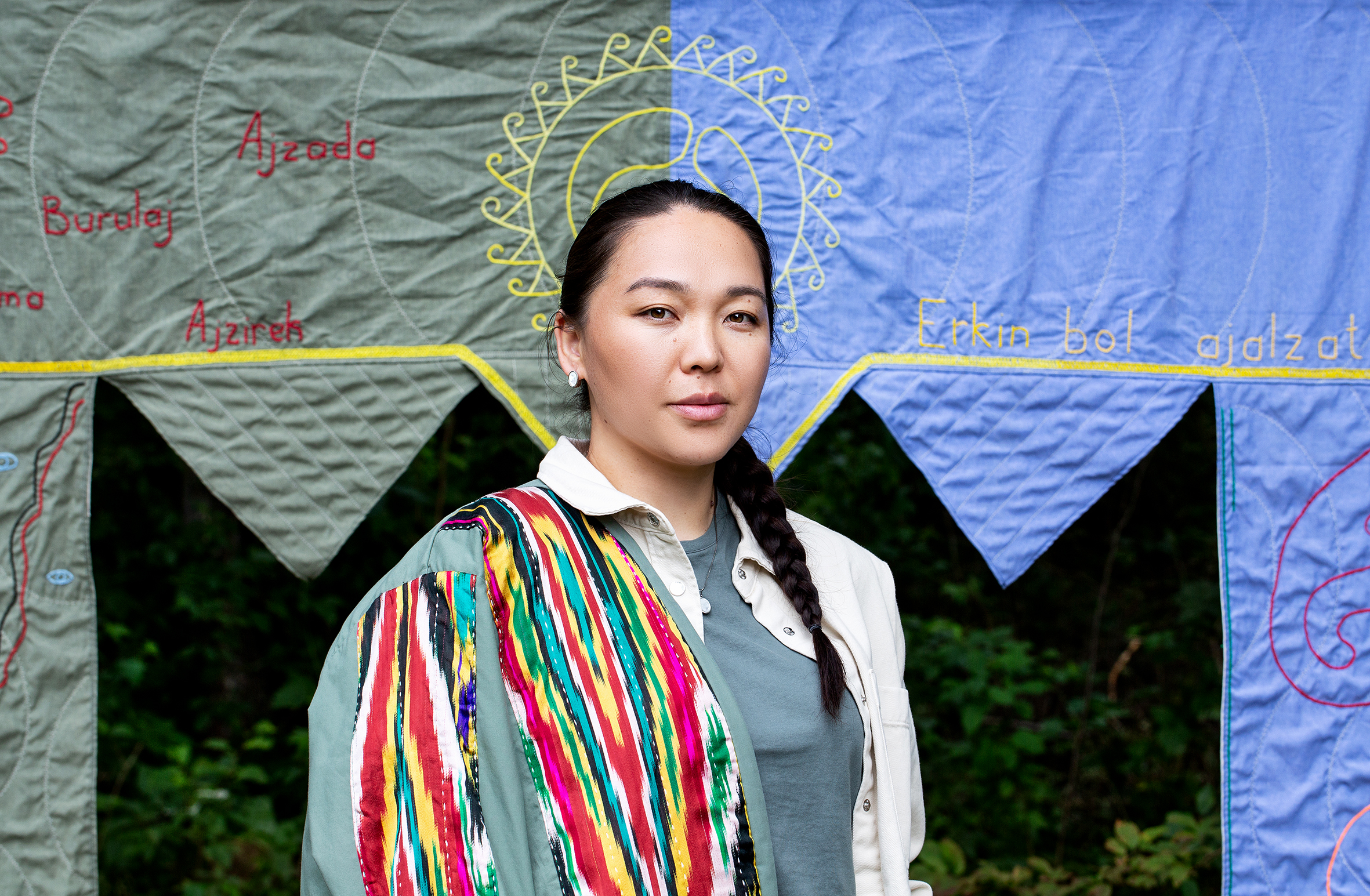
Nurperi Orunbaeva in front of her work "My Heritage" at Hvitsten Salong 2025 (Photo: Aliona Pazdniakova)

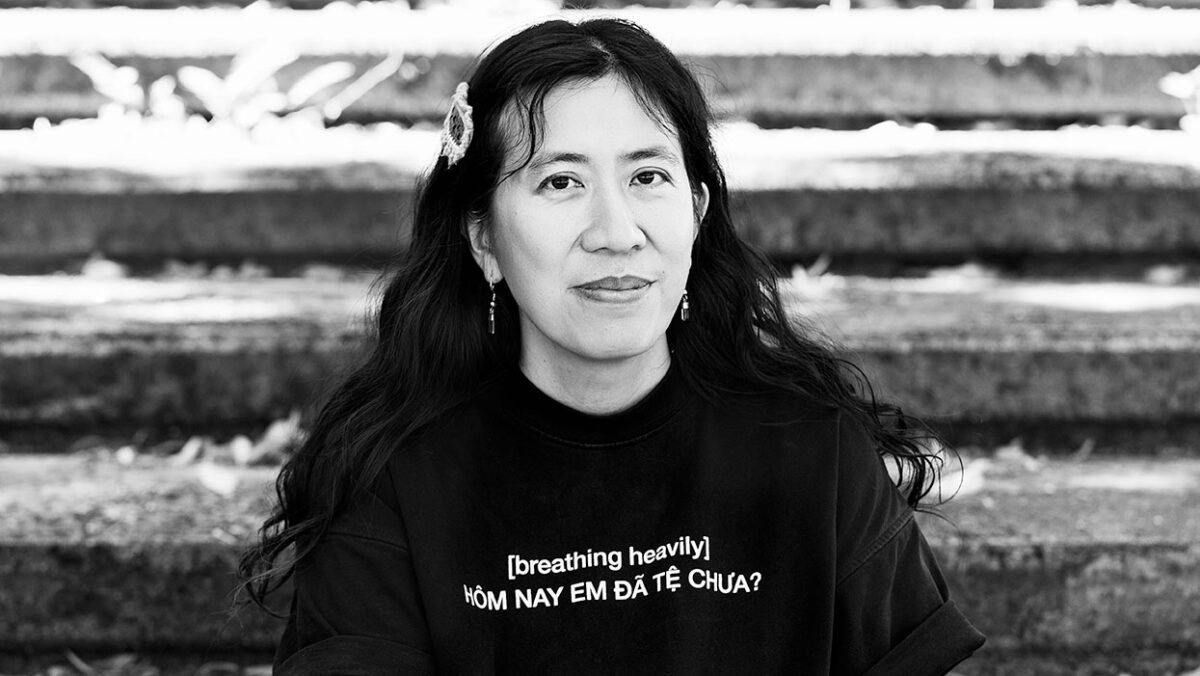
Nurperi Orunbaeva (b. 1994) is a multidisciplinary artist, curator, art activist, and advocate for women’s rights based in Bishkek, Kyrgyzstan. Her artistic practice encompasses a diverse range of media, techniques, and scales, including wall painting, painting, graphics, sculpture, installations, textiles, and more. Nurperi’s artistic approach integrates a conceptual framework with a direct statement and bold expression. Her unwavering commitment to women’s rights, the historical legacy of her nation, and its cultural heritage serve as the foundation for her artistic ideas. In many of her works, she addresses the experiences of women subjected to suppression and violence, yet they persist in their pursuit of light. Nurperi delves into the past, reflecting on the darkest chapters in her nation’s history. Through her installations, she juxtaposes the past and present, presenting them in a contemporary context.

From June 2025, Nurperi is an artist in residence at Hvitsten Art Haven. During this period, she anticipates making new connections and friendships within the Norwegian art world, as she firmly believes in the transformative power of community in combating oppressive systems. She emphasises, that only together can we make a meaningful change. Peri seeks a break from her customary routine and the daily challenges of securing employment and pursuing small projects. She appreciates the opportunity to simply engage in her artistic practice without the constraints of risk, judgment, or persecution. She enjoys visiting Norwegian museums and galleries, as art and history are her profound passions and driving forces in life. The opportunity of participating in diverse cultural events and exhibiting her work fills Peri with immense joy.

Art as an act of courage

“I dedicate my life to culture and art” – this stand-out sentence was written by Peri in her residency application.

Peri’s journey into the art world is a captivating story. Initially pursuing a career in medicine, she successfully completed her studies and worked as a dentist for a period following her graduation. However, the tumultuous years of 2019 – 2020, marked by the pandemic, catalysed a profound transformation in her life. Dramatic events transpired in Peri’s life and the lives of her friends and family, all the injustices of society made her realise that the oppressed position of women was the theme she cared most about. This, coupled with the feeling that she did not want to be a dentist but rather was compelled to fulfil her family’s expectations and pursue a “proper” profession, led Peri to make a radical decision. On January 1, 2021, she resigned from her medical career and joined her community as an artist, immediately engaging herself in all possible artistic activities. However, she describes this decision as natural and light-hearted, as being an artist had always been the dream of her life.

– All my childhood and youth, I closely observed my grandparents, parents, and all the relatives, witnessing their proficiency in various crafts. It was inevitable that I would inherit these skills and develop a knack for them. My keen eye, sharp memory, inventiveness, and innate sense of justice have contributed to the development of my conceptual vision. I became a repository of not only my personal history but also the collective history of my family and nation. Thanks to a long search for myself, I picked up a lot of handcrafts and techniques. I strive to apply these acquired knowledge effectively in my artistic practice, using them to tell the important stories”, Peri tells.

Art for Peri is deeply intertwined with the concept of freedom of expression, which she perceives as a fundamental capacity and the courage to create. This profound understanding of art has been shaped and reinforced by her life experiences and personal growth. Throughout her life, she has been subjected to various restrictions and pressures stemming from propaganda and the rigid norms of patriarchal society.

Kyzyl Kamchy, Femicide, Not Jewellery, Sanzhyra, Mountains of Sorrow, Peris – in her works, Peri explores themes of violence, memory and identity. Through her artistic expression and craftsmanship, she weaves a solid narrative comprising various interweaved pieces.

– My area of interest encloses both personal motivation and social engagement. Occasionally, I experience an overwhelming desire to express my views, and certain installations serve as a medium that helps to do it. At other times, I am deeply concerned about the state of my society. While I´m inside my community where everyone shares similar values and interests, I remain oblivious to the rough things that surround us. However, when I´m unexpectedly outside of my environment, on my way home or during a walk, I suddenly realise how ignorant and evildoing our society is.

I derive pleasure from experimentation, as each new idea presents a challenge that I enjoy solving. I find satisfaction in this process. While some facts from the past or present serve as my starting point, I often deviate from this factual material to create a work based on my intuition and interpretation. This process adds an extra layer of significance and conceptualization to my works, Peri reflects.

“I would kill her anyway”

Kyrgyzstan, a country rarely mentioned in our local news channels, is experiencing a flourishing authoritarian regime that particularly affects vulnerable and minority groups, including women, LGBTQ+ community, and artists who have bravely spoken out for women’s and queer´s rights. At home, Peri and her colleagues face numerous challenges. They struggle to secure financial support, working space and exposure for their projects, while simultaneously working under the constant threat of censorship and persecution. Discussing women’s rights is not appreciated by the patriarchal society, and mentioning the struggles of the queer community is considered LGBTQ+ propaganda, leading to potential repressions, fines and arrests.

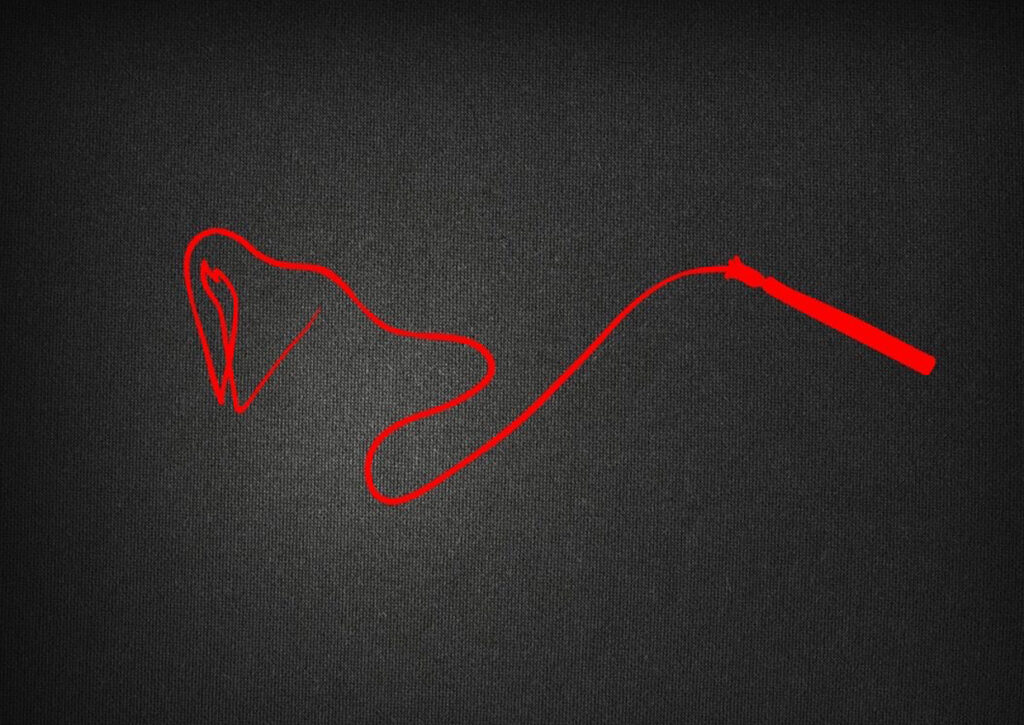
In one of her first works titled “Kyzyl Kamchy”, Peri addresses the subject of domestic violence. She created this piece in response to the pandemic, which brought to light an alarming rise in domestic violence cases. The title “Kyzyl Kamchy” translates from Kyrgyz as “Red Whip”, derived from the blood of women who have been beaten by their husbands.
"Kyzyl Kamchy" / canvas, acrylic, 2022 (Photo: Nurperi Orunbaeva)

I intended to make this artwork in a manner that would be easily comprehensible and recognisable by all Kyrgyz people and everyone who encounter it. I wanted to express the horror of female violence by a single thin line. Each red whip tells a story of pain, survival, or death of a woman. The statistics of female violence is horrific. There is a wish to collect all existing red whips and throw them out of our lives, so that we can finally release our fears and exit this hell of violence.

— Nurperi Orunbaeva

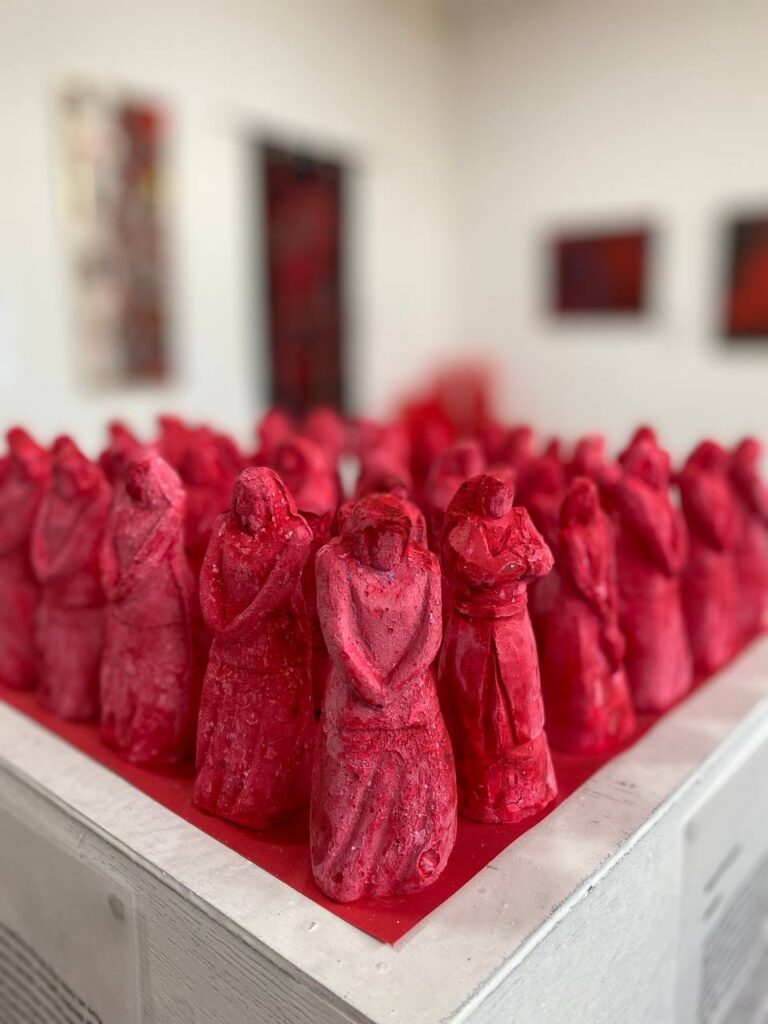
In her next work, Peri expanded the scope of this topic, creating an installation titled “Femicide”.

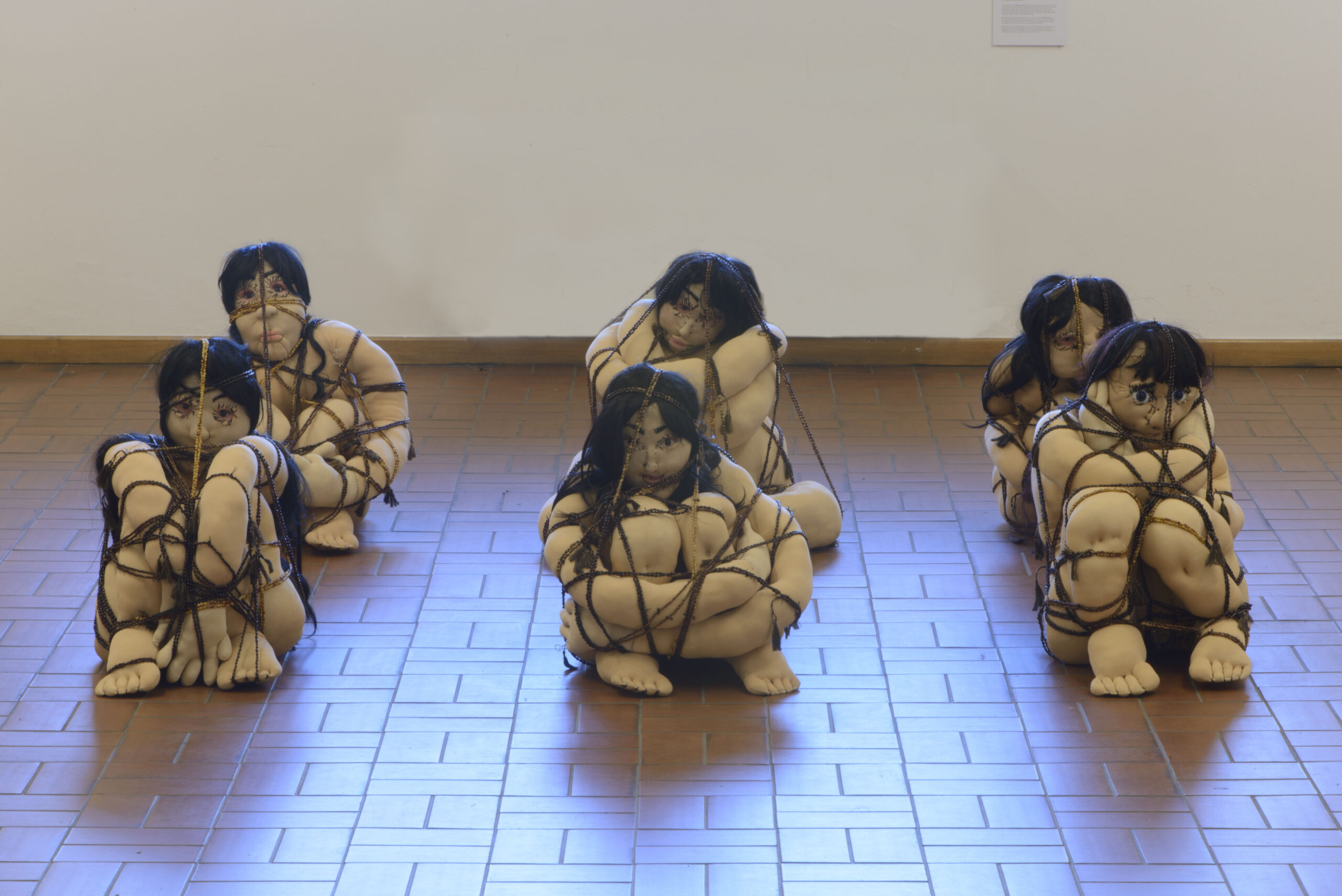
The installation comprises 762 female figures. It is based on a study conducted in Kyrgyzstan that documented 762 criminal cases categorised under the article “Murder” involving the killing of women. Notably, most of these murders were perpetrated by men, with 75% of cases involving individuals who knew the victims, such as intimate partners, relatives, or friends. This alarming and silent data quantifies the magnitude of the tragedy, and the profound sense of vulnerability experienced by women, prompting Peri to create this work in a manner that aims to evoke an understanding of the scale of horror within her society.
"Femicide" / gypsum, acrylic, 2022 (Photo: Nurperi Orunbaeva)

The idea of this installation originated from Peri’s encounter with a research paper “I would kill her anyway,” authored by KLOOP, an organisation prohibited in Kyrgyzstan.

– The fact that there is violence is known everywhere, but not everyone admits this. I have personally witnessed it within my own family, among my relatives, neighbours, and the families of my friends, all around. Upon reading the research, I was deeply moved, particularly by the fact that men often failed to comprehend the gravity of their actions, overlooking domestic violence as an acceptable norm. Some of them had been planning to kill their wives for several months, and many expressed no regrets for their crimes. The pervasive nature of this violence throughout our lives and the lack of understanding of its wrongfulness have left an indelible mark on us all, perpetuating a sense of injustice. I know so many stories of femicide. They tortured me from inside until I began to talk about them through my works. This is my form of fight for the lives and liberation of women, us, Peri emphasises.

Revisiting traditions

Kyrgyz cultural heritage and traditions, which both characterise and affect Kyrgyz society, hold a significant place in Peri´s works. The controversial nature of many of the traditions, shaped within the context of male dominance, often serves as a catalyst for Peri´s artistic process. She makes an example:

– For instance, there exists a tradition known as Ala Kachuu, which involves the kidnapping of young women with the intention of marrying them. This practice often entails severe violence, confinement, and rape. The abducted girl is left hopeless, this is the end for her, as there is no chance to escape the captor’s house, due to the shame, as it will leave her with a “scar” that would haunt her and her family for the rest of her life. In certain cases, the abducted girl may remain married to her captor for the entirety of her life, while in other instances, the marriage may dissolve within a single year.

“Not Jewellery” installation by Peri is a work that draws inspiration from traditional Kyrgyz crafts and serves as a commentary on the ambivalent nature of patriarchal traditions in Kyrgyz society. While many Kyrgyz traditions are beautiful, solid, and rich, they often play a role of a camouflage for the promotion of patriarchal values. These traditions frequently marginalise female roles, labour, and restrict women’s rights and freedom. These rigid traditions do not decorate society but rather highlight its weakness and impediments to development. Each ring of jewellery cast from lead in this installation is referred to “uyat,” which symbolises the burdensome legacy of patriarchal values that have been passed down through time.

"Not Jewellery" / lead one-piece molding, weaving, 2023 (Photo: Cholpon Asanakunova)

All actions, statements, and events that contain malevolent intentions to humiliate, insult, or kill women do not decorate; this is the ugliness of society.

—  Nurperi Orunbaeva

In her work “Sanzhyra” Peri refers to the genealogical book, an ancient spiritual heritage of the Kyrgyz people, that was disseminated orally from generation to generation. This knowledge serves as a means of familiarising individuals with their ancestors and relatives, with the primary objective of preventing incest. In her installation, Peri highlights the absence of female names in her family’s lineage, a genealogical tree that disregards their vital roles and denies their contributions. Through her work, Peri seeks to reclaim the place and recognition of these women.

– During my childhood, we were instructed to become familiar with the names of our relatives and to trace our family lineage predominantly on the paternal side (we were required to know 7 names of our paternal side), where female names were notably absent. My sisters and I frequently questioned this practice, as we were unable to find the names of our grandmothers and mother. We experienced a strong sense of injustice and decided to write our names in the book after our father’s names – it was so much fun, Peri recalls.

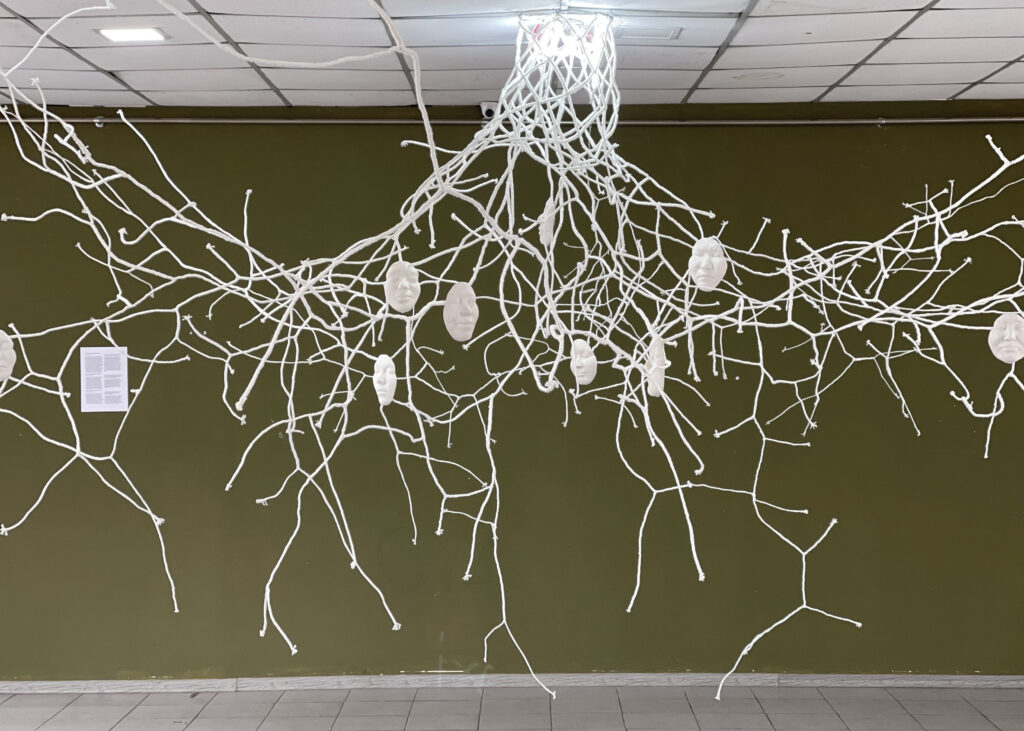
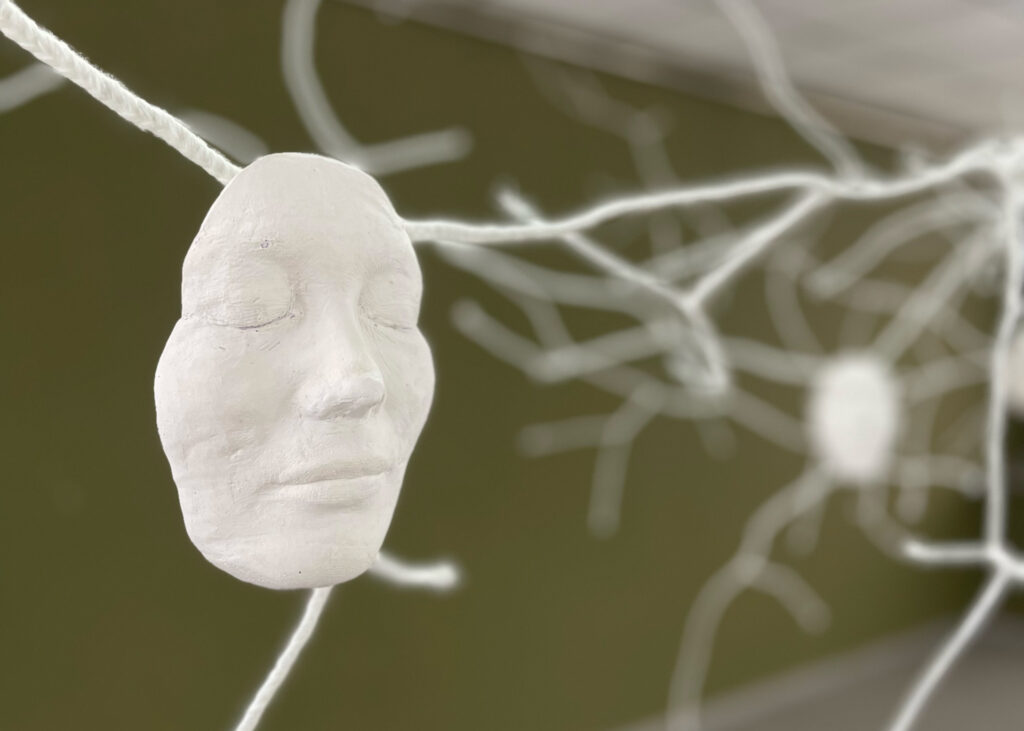
In Kyrgyz culture, Sanzhyra is often depicted as a tree. In her own female Sanzhyra, Peri employs a metaphor of tree roots, creating a network of women that symbolises the fundamental origin of any genealogy. Alongside large, white roots resembling long white braids of her grandmothers, there are faces of her colleagues and friends, women from MoFA+, connecting several generations of women. This installation effectively weaves together the subtle presence of heroic female figures of the past with contemporary activists fighting for female rights, making it a vibrant representation of the vital force that sustains our lives.

"Sanzhyra" / gypsum, acrylic, 2023 (Photo: Nurperi Orunbaeva)

I believe that the invisible role of women is like these roots: without them the tree would not have sprouted so huge! I deeply respect and actively explore the female lineage in my family history. It’s very important to me. I experience an intense sense of warmth and deep connection to my mother’s line, when I´m working. I perceive my role as a means of honouring women in our genealogy and visualising the profound bond between mothers and women in general.

—  Nurperi Orunbaeva

Reclaiming the self

In patriarchal societies, women often grapple with a profound and shared identity crisis stemming from their oppressed position. While acknowledging this injustice, many women succumb to apathy, dismissing any potential for change and ultimately failing to fully embrace their authentic selves. Those who dare to stand up, raise their voices and try to challenge these suppressed conditions encounter an abyss as they search for who they are, a question that was suppressed during their childhood and youth, denying them the opportunity for exploration.

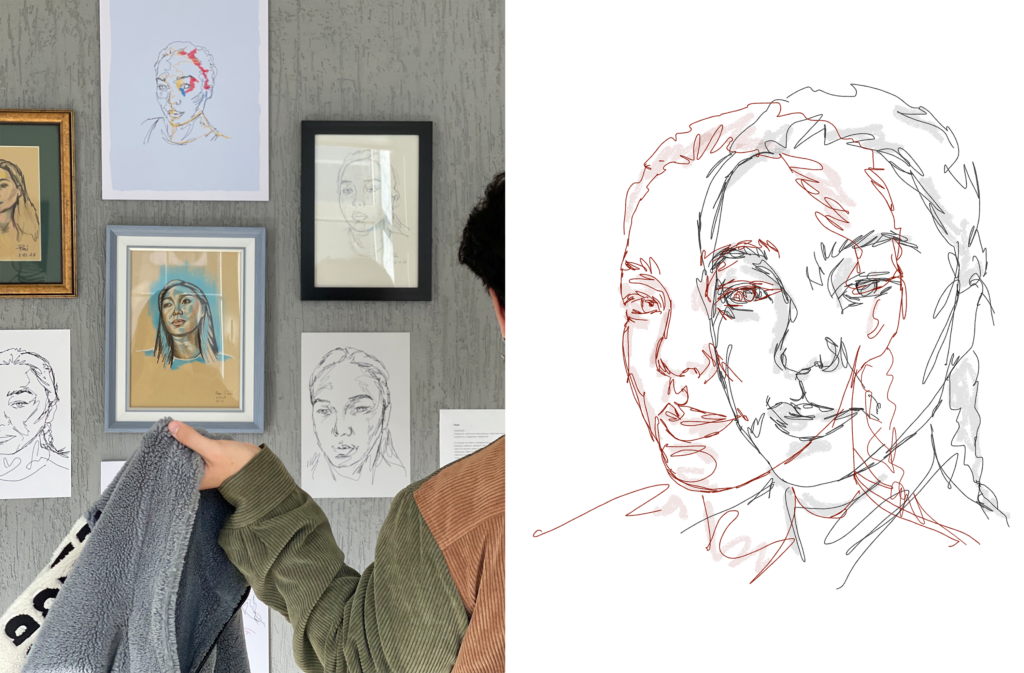
In her work titled “Peris”,  Peri initiates a journey of self-discovery by simply gazing into the mirror and drawing what she sees. As she recognises that each time she engages in this process, she discovers a new version of herself, she decides to dedicate herself to this endeavour without rushing it. Her intention extends beyond mere identity exploration; she yearns to embrace this transformative journey with joy and find a sense of self-return, seeking for re-connection with the authentic self that was once taken from her and remains elusive.

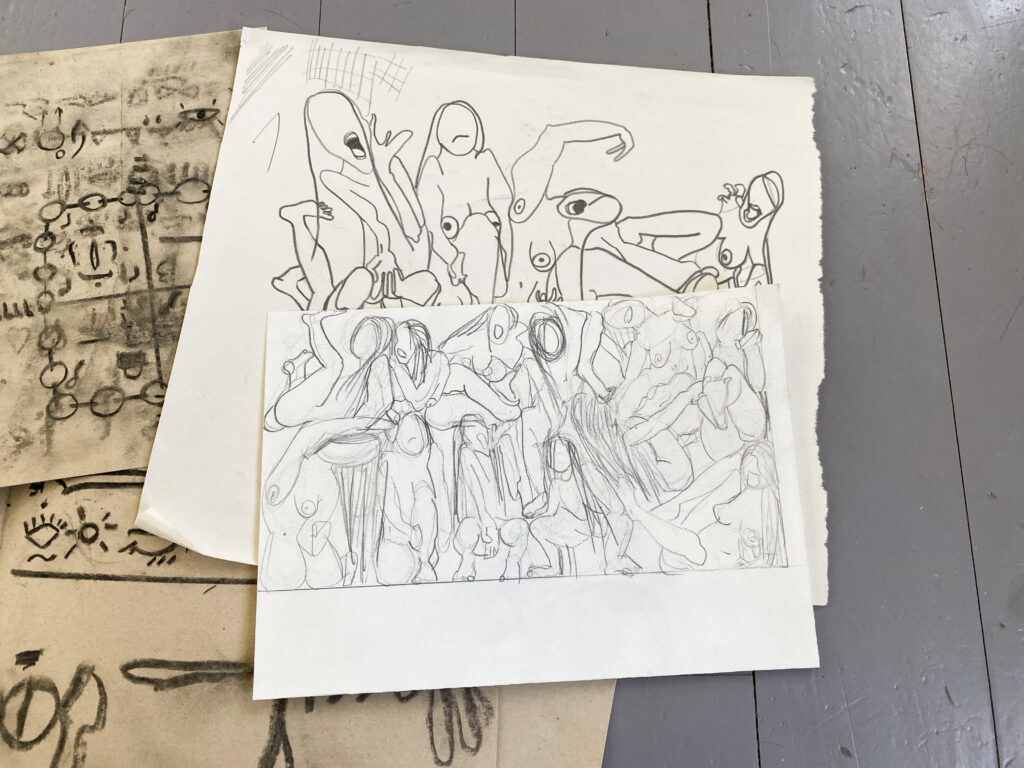
"Peris" / graphic, pencils, craft paper, watercolour, digital graphic, 2023 (Photos: Nurperi Orunbaeva)

– During the pandemic my ground was severely shaken, I had to save myself but also my friends: I had to claim their salaries, deal with threats and blackmail, work tirelessly, and strive to survive. Additionally, I had to provide for my entire family, who were facing significant hardships. One day, as I was walking through one of the corridors, I noticed a silhouette that was moving at the same slow pace as I was. I stopped for a moment and then realised that the silhouette was my reflection in the mirror. I did not recognise myself: my eyes, hair, and features were all foreign to me.

At the age of 26, with my parents still alive, I had transformed into an exhausted, shapeless, dull, and grumpy girl. I had never been able to express myself because I had to be a good girl. No questions about the identity, relationships, or personal development. Then, I began to wonder when this all had started and how it had gone so wrong. I realised that for a long time ago I had been lost in siblings and all my responsibilities.

I´m the first child of my parents, in addition, I´m a daughter. This means that all my life I had to be a third parent, not only for my siblings, but also for my parents. I was never allowed to be a child.

Since my early childhood, as a first-year schoolgirl, I have memories of coming back home after classes and washing asses of my sisters, then cooking food to them, then cleaning the house. This lasted for a very long time. I separated with my parents when I was 29, and only since then did I start to live my own life, I began to take care of myself, invest in myself, listen to myself and love myself, Peri shares.

The driving force of the community

During the Covid, Peri realised that she is not alone in her process and that she was part of a supportive community of women facing similar challenges and seeking solutions. In 2022, she joined MoFA+, where she has progressed through various roles, including volunteer, artist, and curator.

The Central Asian Museum of Feminist and Queer Art (MoFA+) was established in 2019 following the successful exhibition “Femminale”.

– The first Feminnale was a groundbreaking event that garnered substantial attention and resonance. It appears everyone got to know about the exhibition. The public was shocked, and authorities were offended, leading to their immediate attack on the organisers. Altyn Kapalova (one of the MoFA´s founders) suffered greatly from this. Although I was not present at the exhibition, I closely followed the unfolding events on social media, witnessing a real hunt that has begun from all possible sides.

Since the legalisation of the “Propaganda of LGBT” law, our partners and investors (who were relatively few) have stopped their collaboration with MoFA+. We were ordered to cease discussing women’s rights. We have lost our studio and the museum´s art archive had to be relocated and stored at Altyn´s house. Our salaries were dependent on fees generated from participating in projects, and despite our attempts to operate underground, the combination of financial constraints and prohibitions rendered the museum’s functioning impossible. As a result, we are currently taking a so called “creative vacation”, Peri explains.

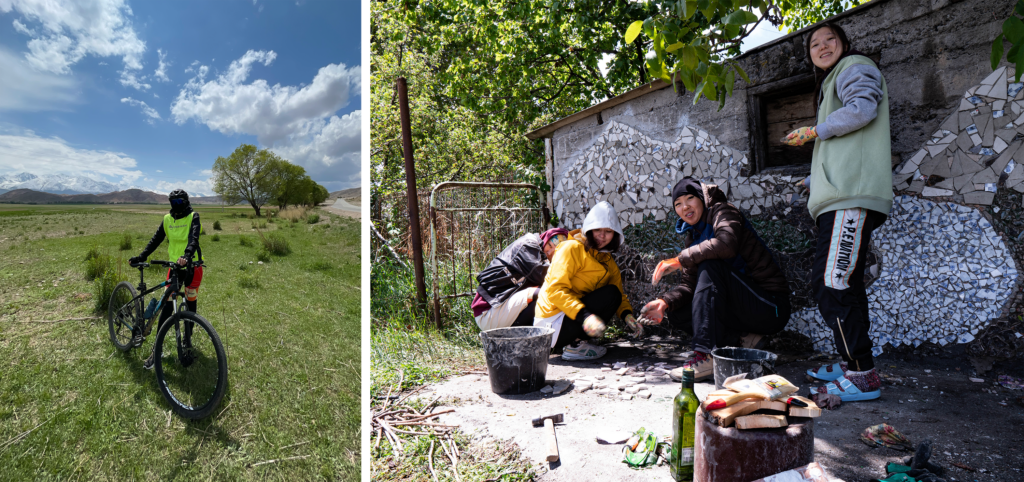
During the first promising years of MoFA´s life, Peri actively participated in numerous projects, engaging in various creative endeavours such as making artworks, helping with photo and video documentation, taking part in and curating exhibitions and Buddhist art expeditions, as well as art bicycle rides.

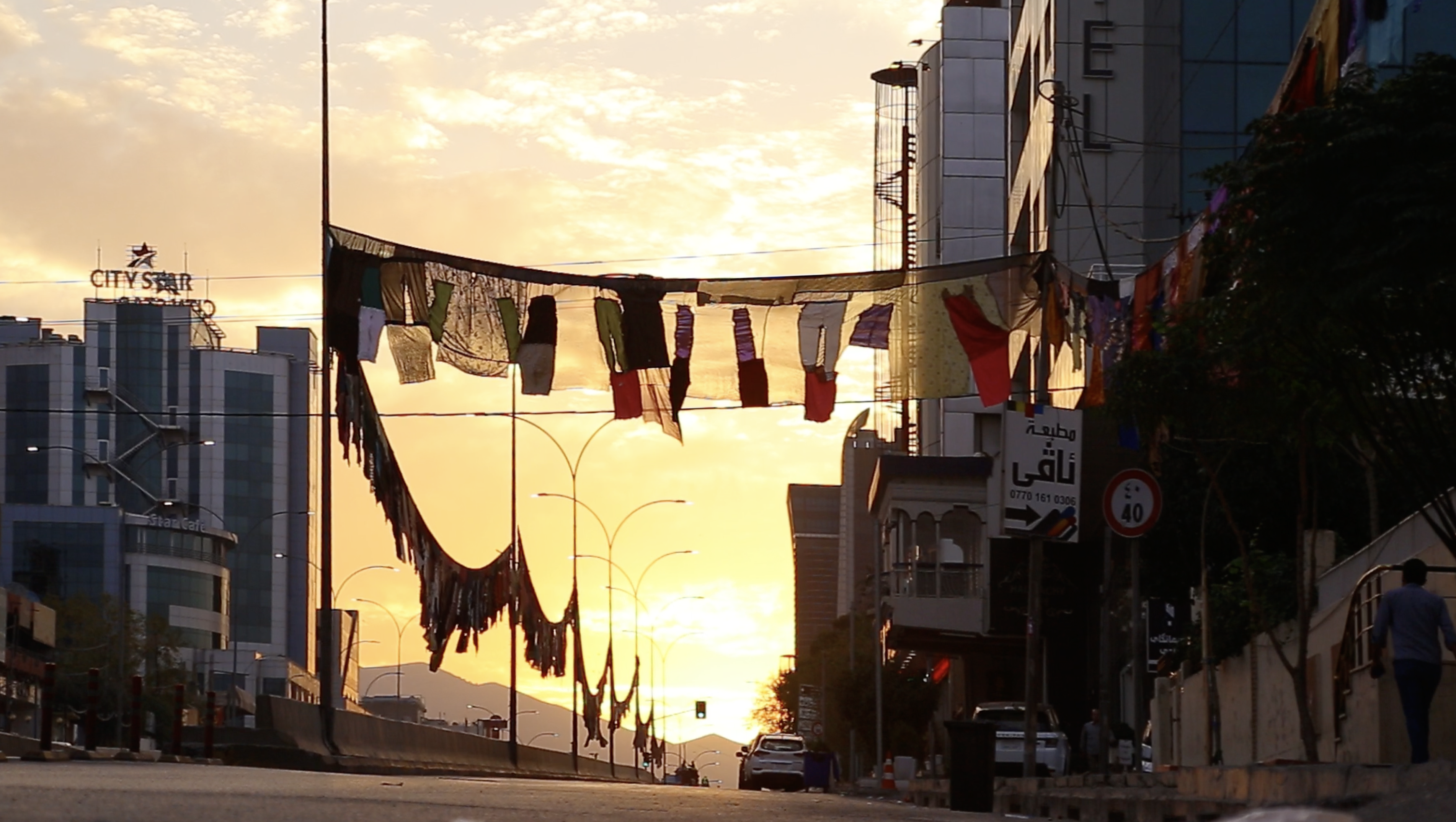
Art bicycle ride around lake Ysyk-Köl, 2023 (Photos: Ayka and Cholpon Asanakunova)

– To organise art bicycle rides for female artists, feminists and women supporting other women and the queer community, was the big dream of Altyn.

Ones she made a research based on a questionnaire made to fellow female artists where she asked, amongst other things: “Are you free?”, where the answers were predominantly “yes”. However a subsequent question  “Whom do you usually ask for the allowance to meet your friends?” was followed by the replies: “My husband, or my father, or my brother”.

The purpose of the art bicycle ride was to demonstrate to women in Kyrgyzstan and Central Asia that we truly possess freedom of movement, Peri describes.

The bicycle ride around lake Ysyk-Köl, which took seven days, has already occurred twice in 2022 and 2023. Peri recounts her exhaustion during the first attempt, describing herself as ambitious, passionate, but very inexperienced as a cyclist.

– During the first ride my face flushed a vibrant red due to all the intense wind and hardcore cycling, and only the strong spirits could sometimes help, Peri recalls, laughing.

Art as a form of resistance and empowerment

However, in the second ride, she had already assumed the roles of organiser and curator. During this ride, Peri also managed to create an installation titled “Mountains of Sorrow”, in which she reflects on the tragic events in the history of her nation.

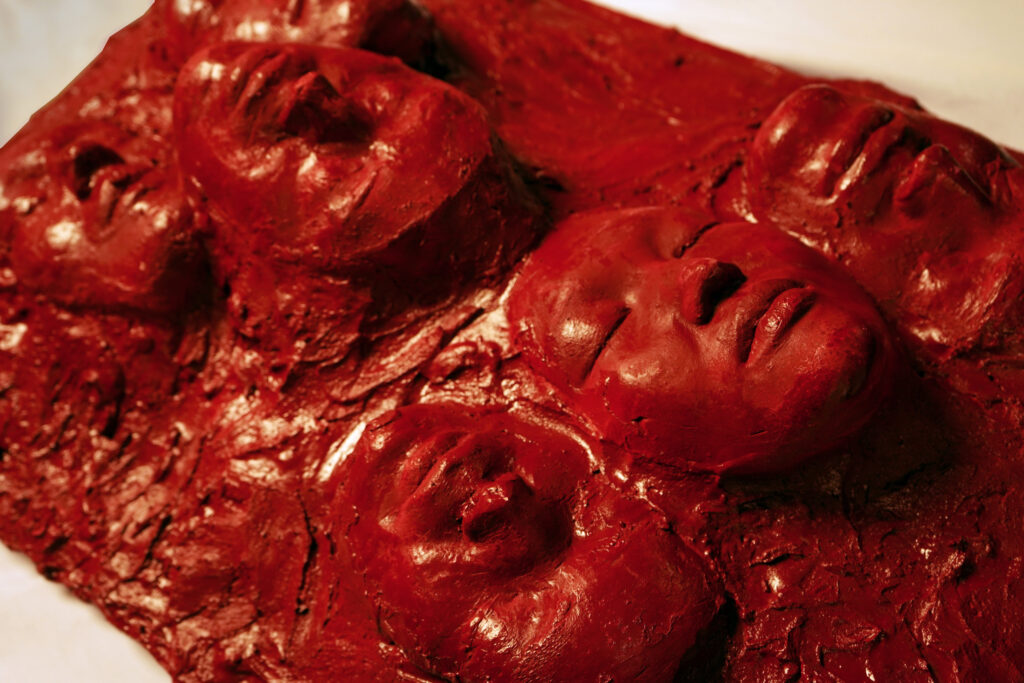
"Mountains of Sorrow" / gypsum, acrylic, 2023 (Photo: Nurperi Orunbaeva)

This ride delves into the tragic history of the Ürkün, a horrific act of ethnic cleansing perpetrated by the Russian Empire in 1916. During this campaign, approximately 40 to 60% of the Northern Kyrgyz population was systematically murdered by Russian forces. Additionally, vast territories were colonised, and numerous animals and treasures were plundered. The genocide compelled countless individuals to flee to China in search of asylum.

“Ürkün” is derived from the Kyrgyz verb “ürküü”, which directly translates to “to shy away in fear” or “to run in panic and recklessly from danger.”

– This word is applicable only while talking about animals, not humans. We thought, it precisely describes the genocide and persecutions committed by the Russian Empire on the territories of Kyrgyzstan. We were collecting the stories of families affected by this horrific mass murder, survivors who returned from China. One such story was recounted by the grandchild of the village major, who vividly described how his grandfather saved his village, but not without the greater cost. He has shown us a mountain that was covered in dead bodies. In my own work, I refer to this story as I wanted to re-create this bloody mountain, which many were unable to climb over, Peri tells.

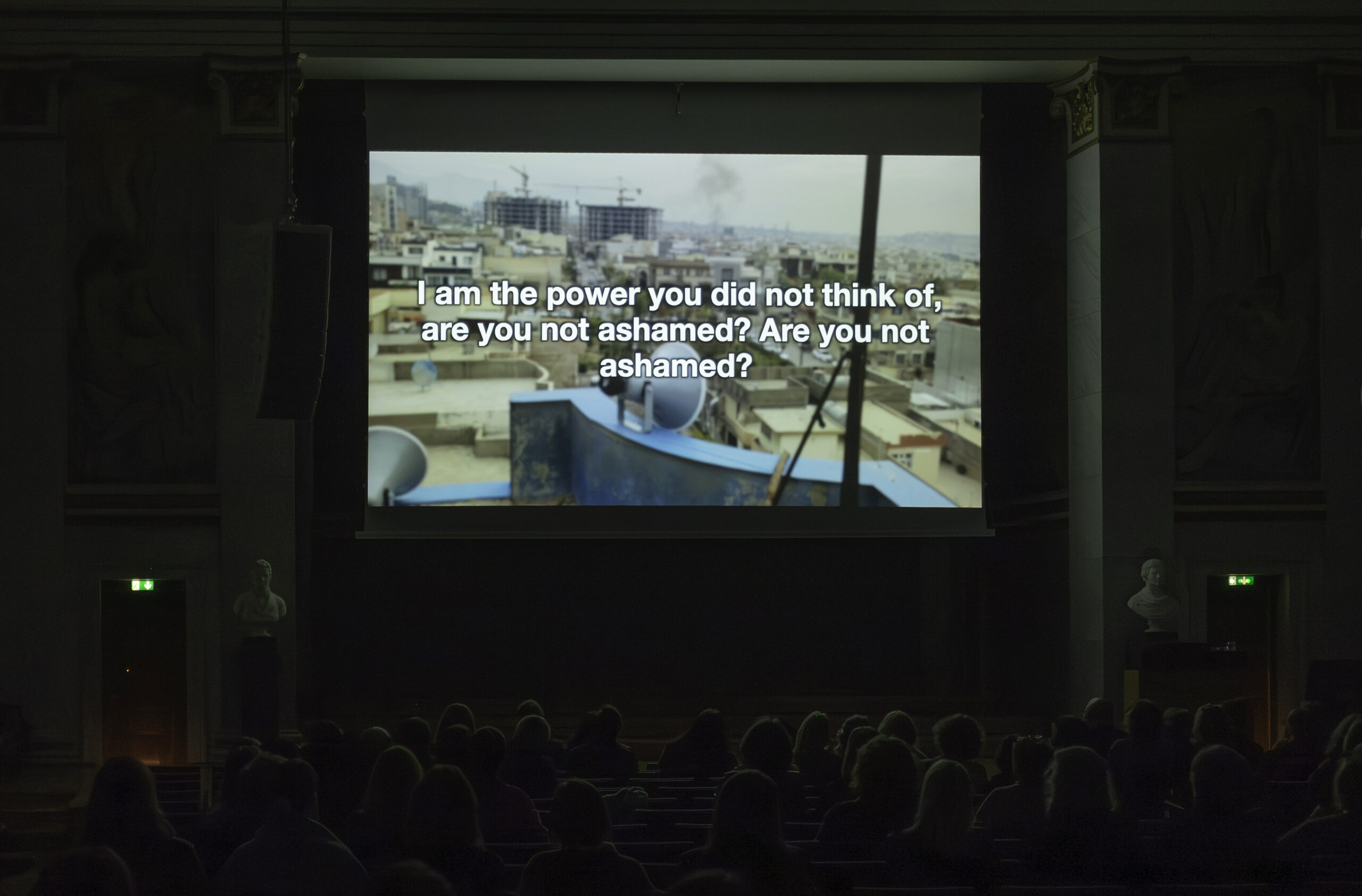
During Peri’s artist talk in Hvitsten, she emphasised that her artistic practice, as well as those of other women in MoFA+, serves as a form of resistance against the oppressive structures of patriarchal society and colonialism. Their primary objective is to reclaim their personal identities and the identities of their nations, which have been stolen from them.

In her artistic activity, Peri bravely and boldly takes a space, presenting her own unique perspective on both her local social and global contexts.

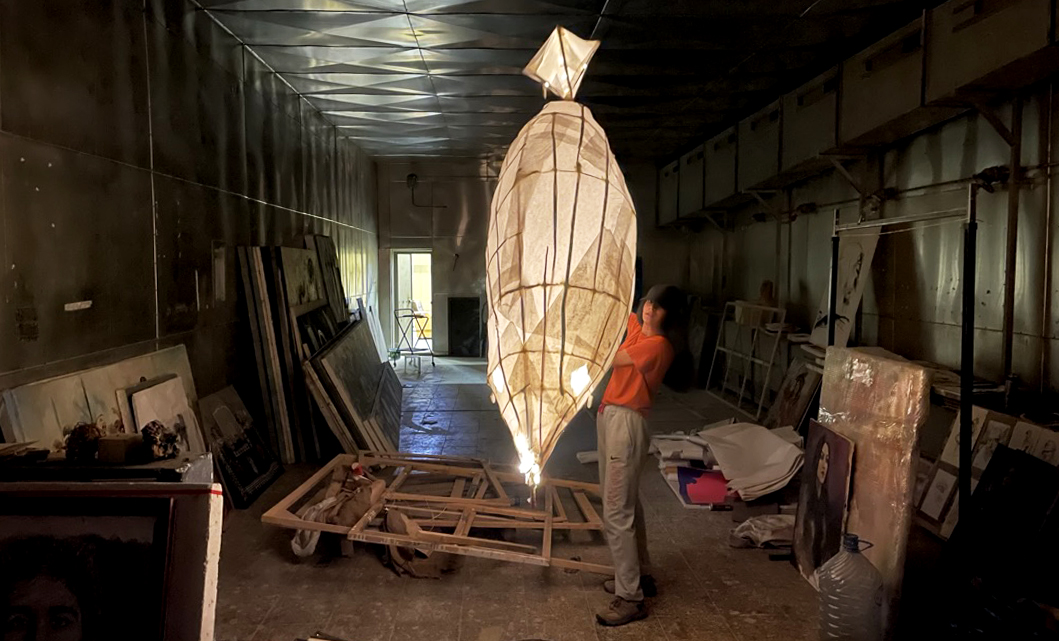
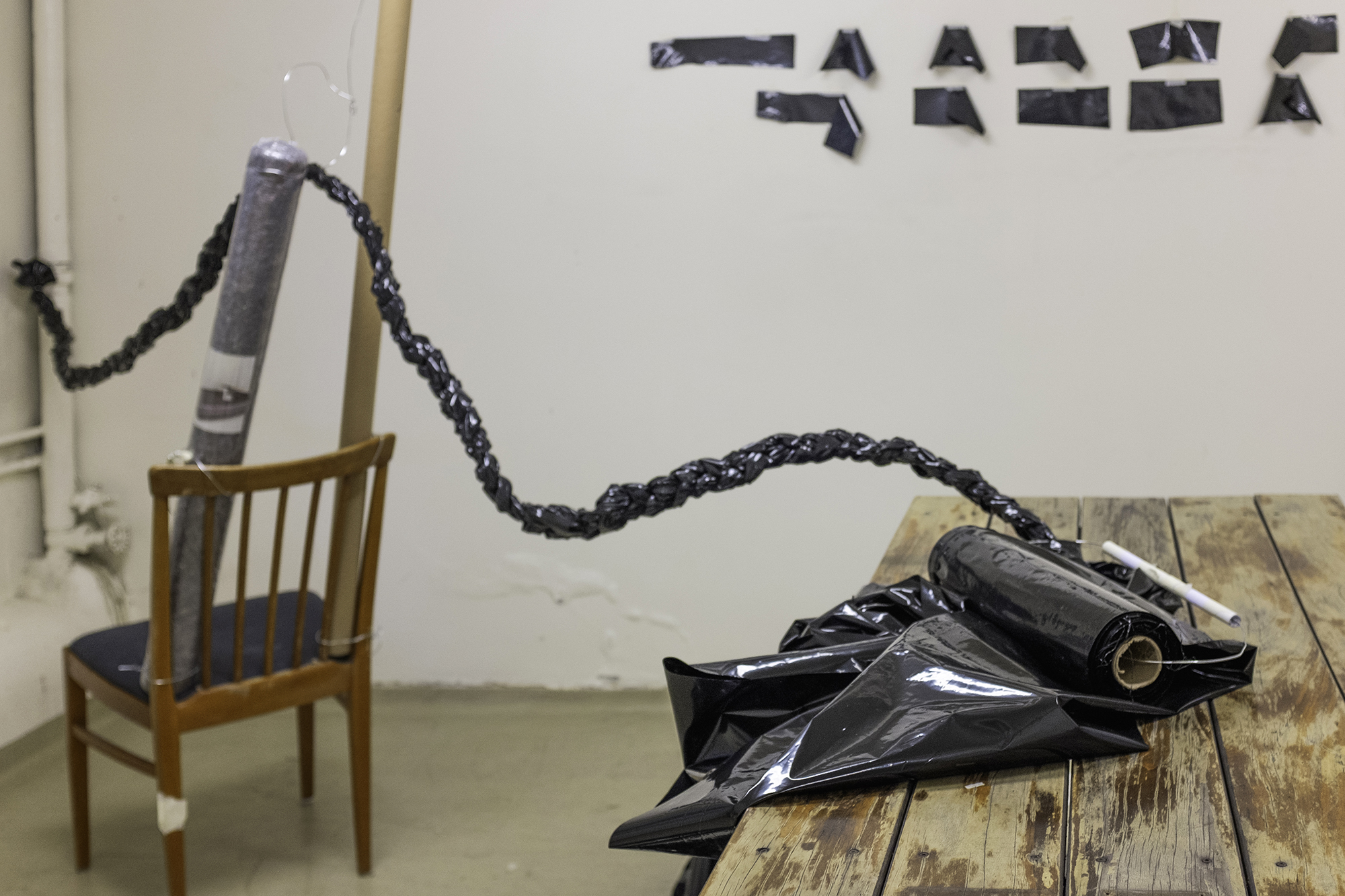
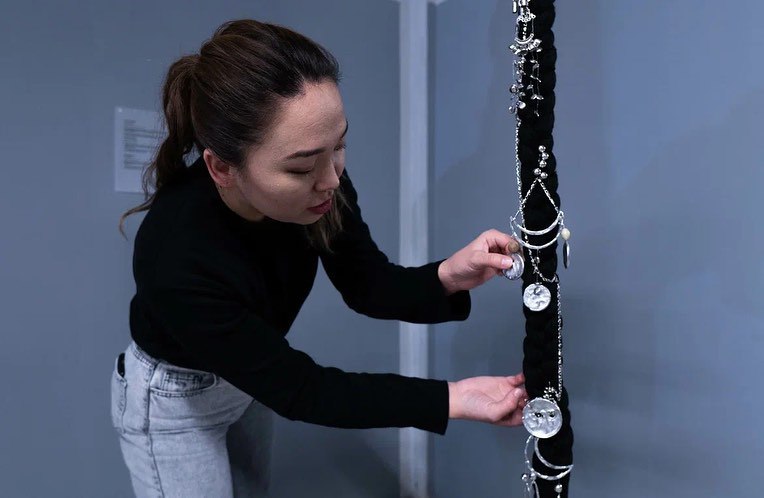
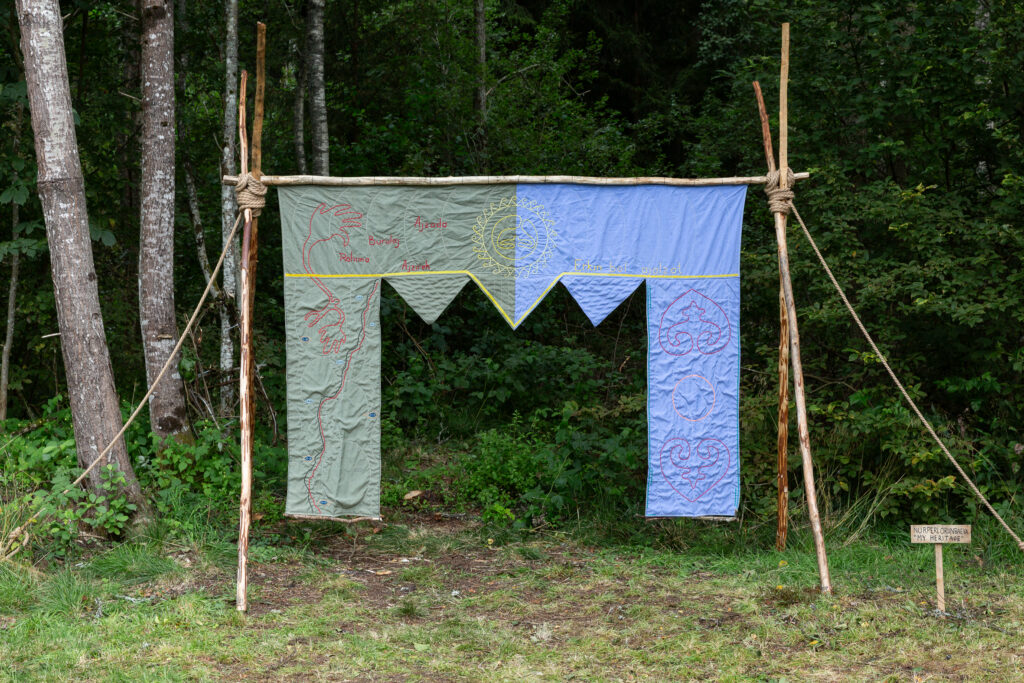
For the Hvitsten Salon 2025, she crafted a textile art piece entitled “My Heritage”. This work is rooted in the Tushtuk tradition, a unique inheritance passed down from a mother to her daughter. Traditionally, every mother begins preparing her tushtuk for the daughter upon her birth. It is scrupulously handmade from intricate patterns imbued with symbolic meanings, often interwoven with prayers, wishes, and aspirations for a prosperous and fulfilling marriage for her daughter.

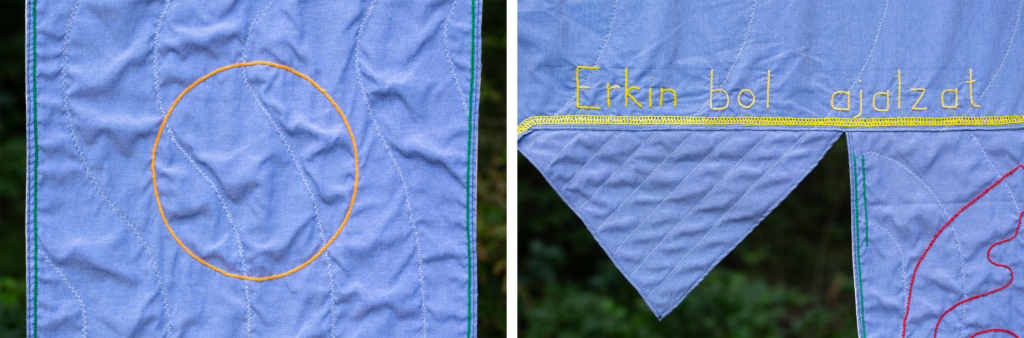
"My Heritage" / textile, sewing, embroidery, 2025 (Photos: Aliona Pazdniakova)

Embracing the tradition while asserting her own interpretation, Peri makes her personal version of tushtuk that she dedicates to all the daughters of the world. She highlights:

– My work is a legacy for all the daughters of the world. It serves as a testament to the empowerment of women, inspiring generations to break free from the constraints of traditional roles. It is not an expectation to be passive and obedient wives, nor is it a demand to silence our voices. Instead, it is a call to embrace our true selves and seek liberation from the oppressive structures imposed by patriarchal societies.

In addition to the names of victims of femicide and her personal choice of symbols, on the front of her tushtuk, Peri embroiders the sole wish that is both a spell, a mantra, and a call to action: Erkin bol ajalzat!Be free, women!

Vi stenger døren for dem som forsvarer menneskerettighetene

Menu Close Safemuse About Us What we do Our five pillars Our history Who we are Our members Media resources Contact Us News Safe residencies Residency programme Oslo Art Haven Hvitsten Art Haven How to apply Projects Safe Havens Conference Women’s network MoFA+ collaboration Salong på Salongen Artistic mobility Artistic Freedom Week LIDIO .SAFE Artists

About Us What we do Our five pillars Our history Who we are Our members Media resources Contact Us News Safe residencies Residency programme Oslo Art Haven Hvitsten Art Haven How to apply Projects Safe Havens Conference Women’s network MoFA+ collaboration Salong på Salongen Artistic mobility Artistic Freedom Week LIDIO .SAFE Artists

About Us What we do Our five pillars Our history Who we are Our members Media resources Contact Us News Safe residencies Residency programme Oslo Art Haven Hvitsten Art Haven How to apply Projects Safe Havens Conference Women’s network MoFA+ collaboration Salong på Salongen Artistic mobility Artistic Freedom Week LIDIO .SAFE Artists ...

Exhibition – Art Captures

Menu Close Safemuse About Us What we do Our five pillars Our history Who we are Our members Media resources Contact Us News Safe residencies Residency programme Oslo Art Haven Hvitsten Art Haven How to apply Projects Safe Havens Conference Women’s network MoFA+ collaboration Salong på Salongen Artistic mobility Artistic Freedom Week LIDIO .SAFE Artists

About Us What we do Our five pillars Our history Who we are Our members Media resources Contact Us News Safe residencies Residency programme Oslo Art Haven Hvitsten Art Haven How to apply Projects Safe Havens Conference Women’s network MoFA+ collaboration Salong på Salongen Artistic mobility Artistic Freedom Week LIDIO .SAFE Artists

About Us What we do Our five pillars Our history Who we are Our members Media resources Contact Us News Safe residencies Residency programme Oslo Art Haven Hvitsten Art Haven How to apply Projects Safe Havens Conference Women’s network MoFA+ collaboration Salong på Salongen Artistic mobility Artistic Freedom Week LIDIO .SAFE Artists ...

Ytringsfrihet i teori og praksis – den oversette kunstneren

Menu Close Safemuse About Us What we do Our five pillars Our history Who we are Our members Media resources Contact Us News Safe residencies Residency programme Oslo Art Haven Hvitsten Art Haven How to apply Projects Safe Havens Conference Women’s network MoFA+ collaboration Salong på Salongen Artistic mobility Artistic Freedom Week LIDIO .SAFE Artists

About Us What we do Our five pillars Our history Who we are Our members Media resources Contact Us News Safe residencies Residency programme Oslo Art Haven Hvitsten Art Haven How to apply Projects Safe Havens Conference Women’s network MoFA+ collaboration Salong på Salongen Artistic mobility Artistic Freedom Week LIDIO .SAFE Artists

About Us What we do Our five pillars Our history Who we are Our members Media resources Contact Us News Safe residencies Residency programme Oslo Art Haven Hvitsten Art Haven How to apply Projects Safe Havens Conference Women’s network MoFA+ collaboration Salong på Salongen Artistic mobility Artistic Freedom Week LIDIO .SAFE Artists ...

Nurperi Orunbaeva: Decolonising the Self through Artistic Practice and Reimagining Ancestral Heritage

Menu Close Safemuse About Us What we do Our five pillars Our history Who we are Our members Media resources Contact Us News Safe residencies Residency programme Oslo Art Haven Hvitsten Art Haven How to apply Projects Safe Havens Conference Women’s network MoFA+ collaboration Salong på Salongen Artistic mobility Artistic Freedom Week LIDIO .SAFE Artists

About Us What we do Our five pillars Our history Who we are Our members Media resources Contact Us News Safe residencies Residency programme Oslo Art Haven Hvitsten Art Haven How to apply Projects Safe Havens Conference Women’s network MoFA+ collaboration Salong på Salongen Artistic mobility Artistic Freedom Week LIDIO .SAFE Artists

About Us What we do Our five pillars Our history Who we are Our members Media resources Contact Us News Safe residencies Residency programme Oslo Art Haven Hvitsten Art Haven How to apply Projects Safe Havens Conference Women’s network MoFA+ collaboration Salong på Salongen Artistic mobility Artistic Freedom Week LIDIO .SAFE Artists ...

Burmese queer film dispatch

Menu Close Safemuse About Us What we do Our five pillars Our history Who we are Our members Media resources Contact Us News Safe residencies Residency programme Oslo Art Haven Hvitsten Art Haven How to apply Projects Safe Havens Conference Women’s network MoFA+ collaboration Salong på Salongen Artistic mobility Artistic Freedom Week LIDIO .SAFE Artists

About Us What we do Our five pillars Our history Who we are Our members Media resources Contact Us News Safe residencies Residency programme Oslo Art Haven Hvitsten Art Haven How to apply Projects Safe Havens Conference Women’s network MoFA+ collaboration Salong på Salongen Artistic mobility Artistic Freedom Week LIDIO .SAFE Artists

About Us What we do Our five pillars Our history Who we are Our members Media resources Contact Us News Safe residencies Residency programme Oslo Art Haven Hvitsten Art Haven How to apply Projects Safe Havens Conference Women’s network MoFA+ collaboration Salong på Salongen Artistic mobility Artistic Freedom Week LIDIO .SAFE Artists ...

Eddie Htet Aung Lwyn: A Dose of Survivor’s Guilt, Recurrent Frustration, and Moments of Overcoming

Menu Close Safemuse About Us What we do Our five pillars Our history Who we are Our members Media resources Contact Us News Safe residencies Residency programme Oslo Art Haven Hvitsten Art Haven How to apply Projects Safe Havens Conference Women’s network MoFA+ collaboration Salong på Salongen Artistic mobility Artistic Freedom Week LIDIO .SAFE Artists

About Us What we do Our five pillars Our history Who we are Our members Media resources Contact Us News Safe residencies Residency programme Oslo Art Haven Hvitsten Art Haven How to apply Projects Safe Havens Conference Women’s network MoFA+ collaboration Salong på Salongen Artistic mobility Artistic Freedom Week LIDIO .SAFE Artists

About Us What we do Our five pillars Our history Who we are Our members Media resources Contact Us News Safe residencies Residency programme Oslo Art Haven Hvitsten Art Haven How to apply Projects Safe Havens Conference Women’s network MoFA+ collaboration Salong på Salongen Artistic mobility Artistic Freedom Week LIDIO .SAFE Artists ...

Saba Pouyeshman: Rewriting the spell, from supperssion to imagination

Menu Close Safemuse About Us What we do Our five pillars Our history Who we are Our members Media resources Contact Us News Safe residencies Residency programme Oslo Art Haven Hvitsten Art Haven How to apply Projects Safe Havens Conference Women’s network MoFA+ collaboration Salong på Salongen Artistic mobility Artistic Freedom Week LIDIO .SAFE Artists

About Us What we do Our five pillars Our history Who we are Our members Media resources Contact Us News Safe residencies Residency programme Oslo Art Haven Hvitsten Art Haven How to apply Projects Safe Havens Conference Women’s network MoFA+ collaboration Salong på Salongen Artistic mobility Artistic Freedom Week LIDIO .SAFE Artists

About Us What we do Our five pillars Our history Who we are Our members Media resources Contact Us News Safe residencies Residency programme Oslo Art Haven Hvitsten Art Haven How to apply Projects Safe Havens Conference Women’s network MoFA+ collaboration Salong på Salongen Artistic mobility Artistic Freedom Week LIDIO .SAFE Artists ...

Pouya Pour-Amin: An artist’s journey from fear to freedom

Menu Close Safemuse About Us What we do Our five pillars Our history Who we are Our members Media resources Contact Us News Safe residencies Residency programme Oslo Art Haven Hvitsten Art Haven How to apply Projects Safe Havens Conference Women’s network MoFA+ collaboration Salong på Salongen Artistic mobility Artistic Freedom Week LIDIO .SAFE Artists

About Us What we do Our five pillars Our history Who we are Our members Media resources Contact Us News Safe residencies Residency programme Oslo Art Haven Hvitsten Art Haven How to apply Projects Safe Havens Conference Women’s network MoFA+ collaboration Salong på Salongen Artistic mobility Artistic Freedom Week LIDIO .SAFE Artists

About Us What we do Our five pillars Our history Who we are Our members Media resources Contact Us News Safe residencies Residency programme Oslo Art Haven Hvitsten Art Haven How to apply Projects Safe Havens Conference Women’s network MoFA+ collaboration Salong på Salongen Artistic mobility Artistic Freedom Week LIDIO .SAFE Artists ...

Meet our newest staff members

Menu Close Safemuse About Us What we do Our five pillars Our history Who we are Our members Media resources Contact Us News Safe residencies Residency programme Oslo Art Haven Hvitsten Art Haven How to apply Projects Safe Havens Conference Women’s network MoFA+ collaboration Salong på Salongen Artistic mobility Artistic Freedom Week LIDIO .SAFE Artists

About Us What we do Our five pillars Our history Who we are Our members Media resources Contact Us News Safe residencies Residency programme Oslo Art Haven Hvitsten Art Haven How to apply Projects Safe Havens Conference Women’s network MoFA+ collaboration Salong på Salongen Artistic mobility Artistic Freedom Week LIDIO .SAFE Artists

About Us What we do Our five pillars Our history Who we are Our members Media resources Contact Us News Safe residencies Residency programme Oslo Art Haven Hvitsten Art Haven How to apply Projects Safe Havens Conference Women’s network MoFA+ collaboration Salong på Salongen Artistic mobility Artistic Freedom Week LIDIO .SAFE Artists ...

Meet our newest staff member

Menu Close Safemuse About Us What we do Our five pillars Our history Who we are Our members Media resources Contact Us News Safe residencies Residency programme Oslo Art Haven Hvitsten Art Haven How to apply Projects Safe Havens Conference Women’s network MoFA+ collaboration Salong på Salongen Artistic mobility Artistic Freedom Week LIDIO .SAFE Artists

About Us What we do Our five pillars Our history Who we are Our members Media resources Contact Us News Safe residencies Residency programme Oslo Art Haven Hvitsten Art Haven How to apply Projects Safe Havens Conference Women’s network MoFA+ collaboration Salong på Salongen Artistic mobility Artistic Freedom Week LIDIO .SAFE Artists

About Us What we do Our five pillars Our history Who we are Our members Media resources Contact Us News Safe residencies Residency programme Oslo Art Haven Hvitsten Art Haven How to apply Projects Safe Havens Conference Women’s network MoFA+ collaboration Salong på Salongen Artistic mobility Artistic Freedom Week LIDIO .SAFE Artists ...

© Safemuse Organisation - Oslo/Norway

Categories
News Project Safe Havens Safe Residencies

Eddie Htet Aung Lwyn: A Dose of Survivor’s Guilt, Recurrent Frustration, and Moments of Overcoming


Eddie Htet Aung Lwyn: A Dose of Survivor’s Guilt, Recurrent Frustration, and Moments of Overcoming

August 13, 2025

Written by Kate Ngan Wa Ao

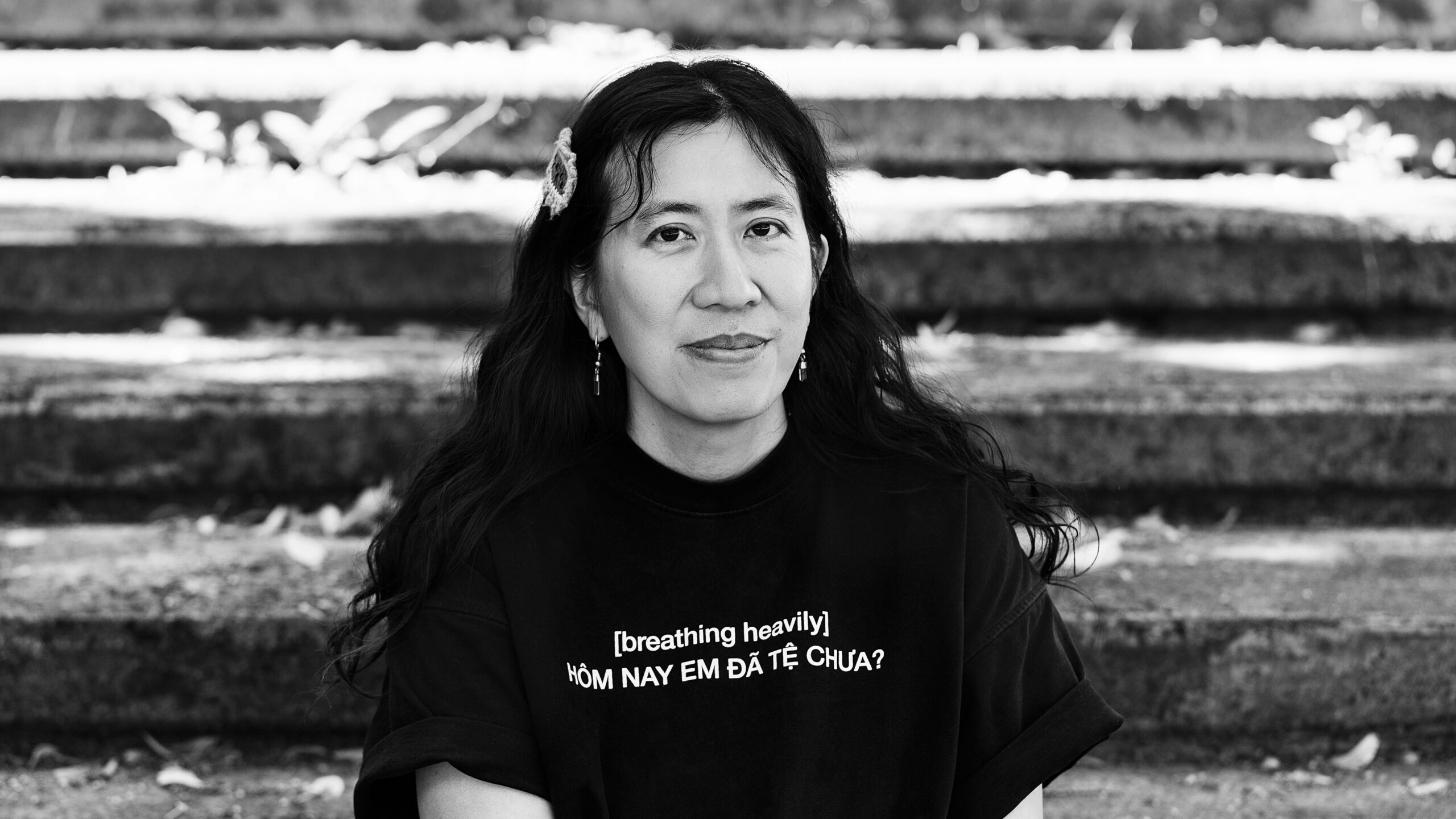
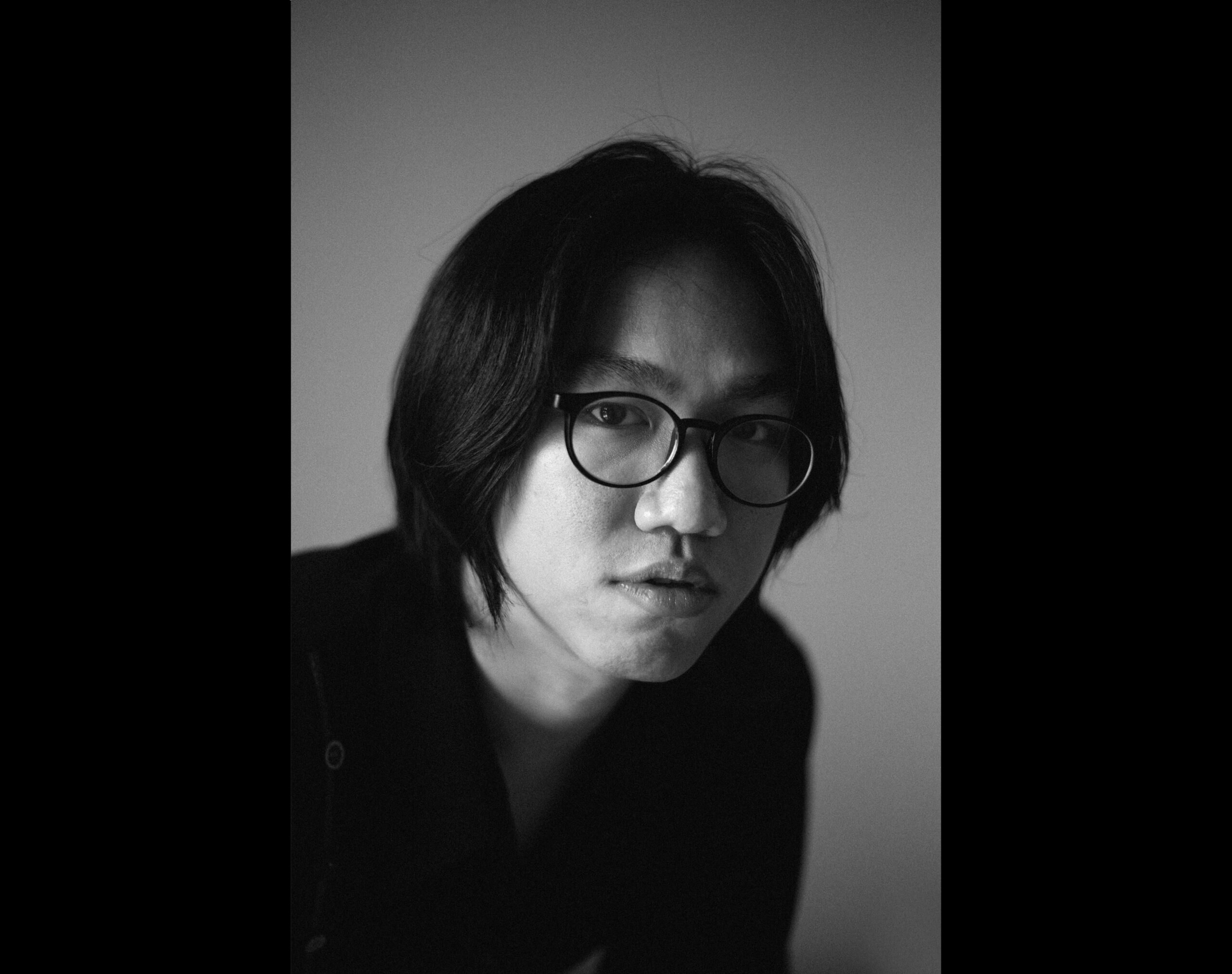
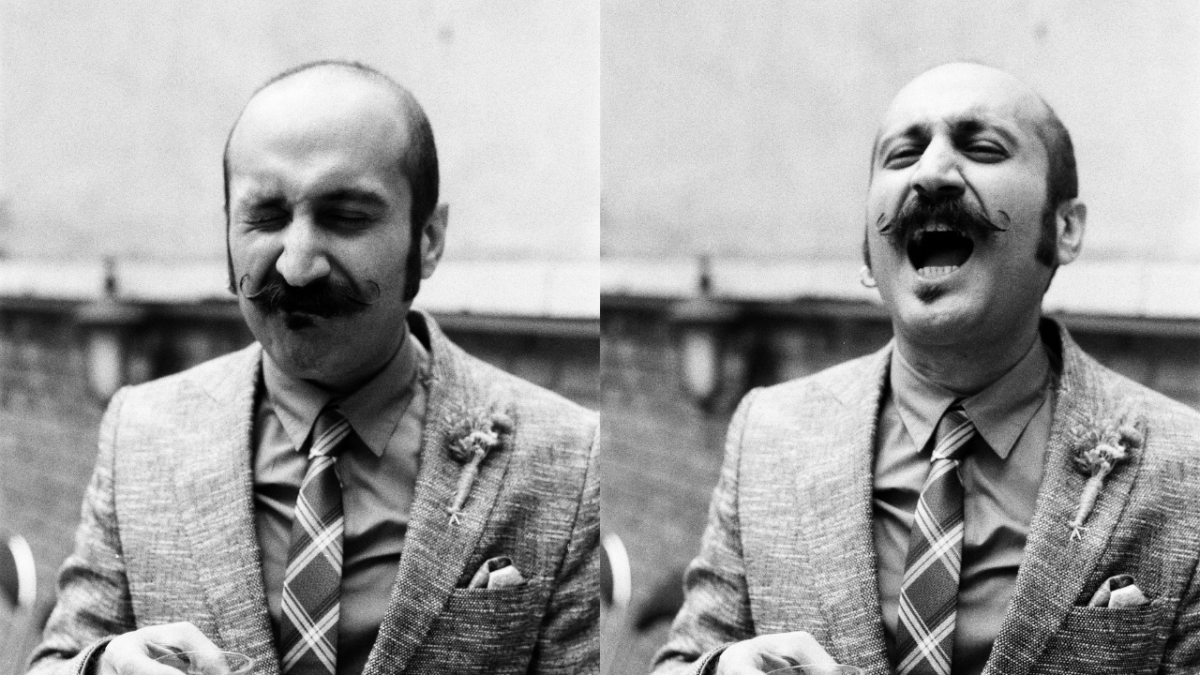
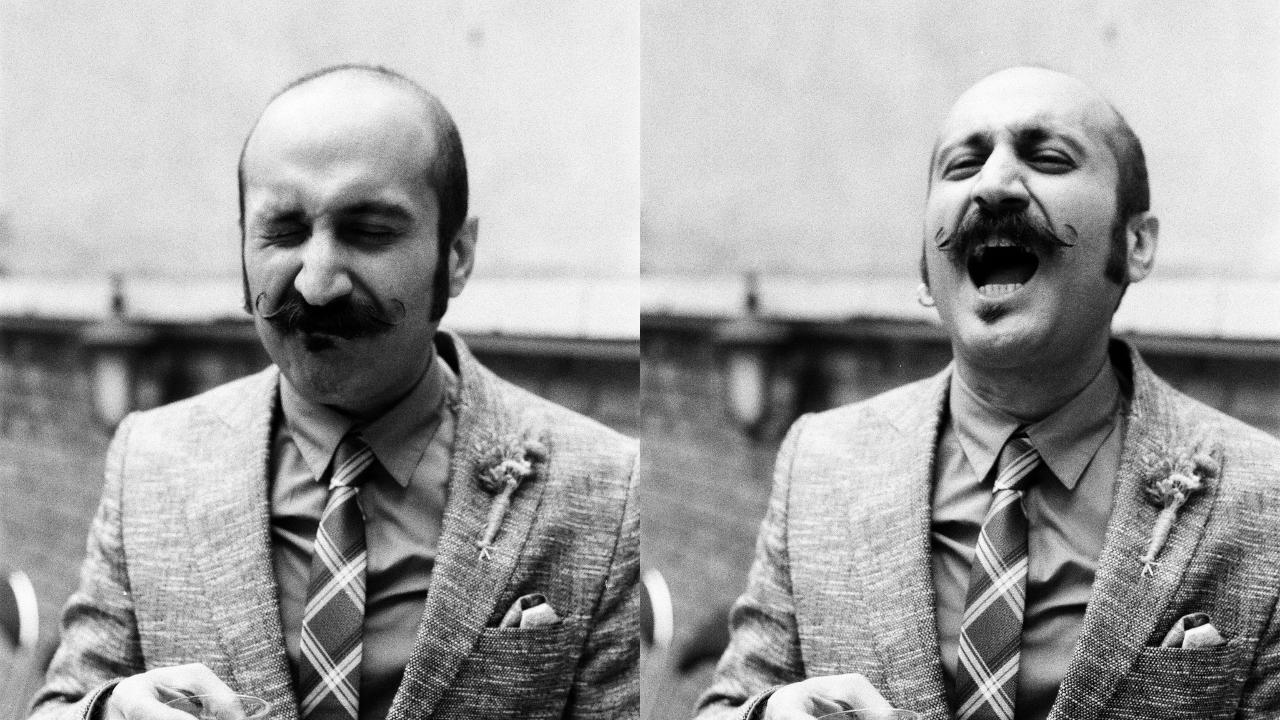
Eddie Htet Aung Lwyn. A Burmese filmmaker and photographer from Myanmar.(Photo: courtesy of the artist)
“Artistic Freedom for me is to create despite the government and the powers that be. It is honouring the purest part of a person who wants to create and speak truthfully to oneself. It has now become a privilege, even though it should not be. But it is a privilege I embrace with a dose of survivor’s guilt, recurrent frustration, and eventual brief overcoming of it.”

— Eddie Htet Aung Lwyn

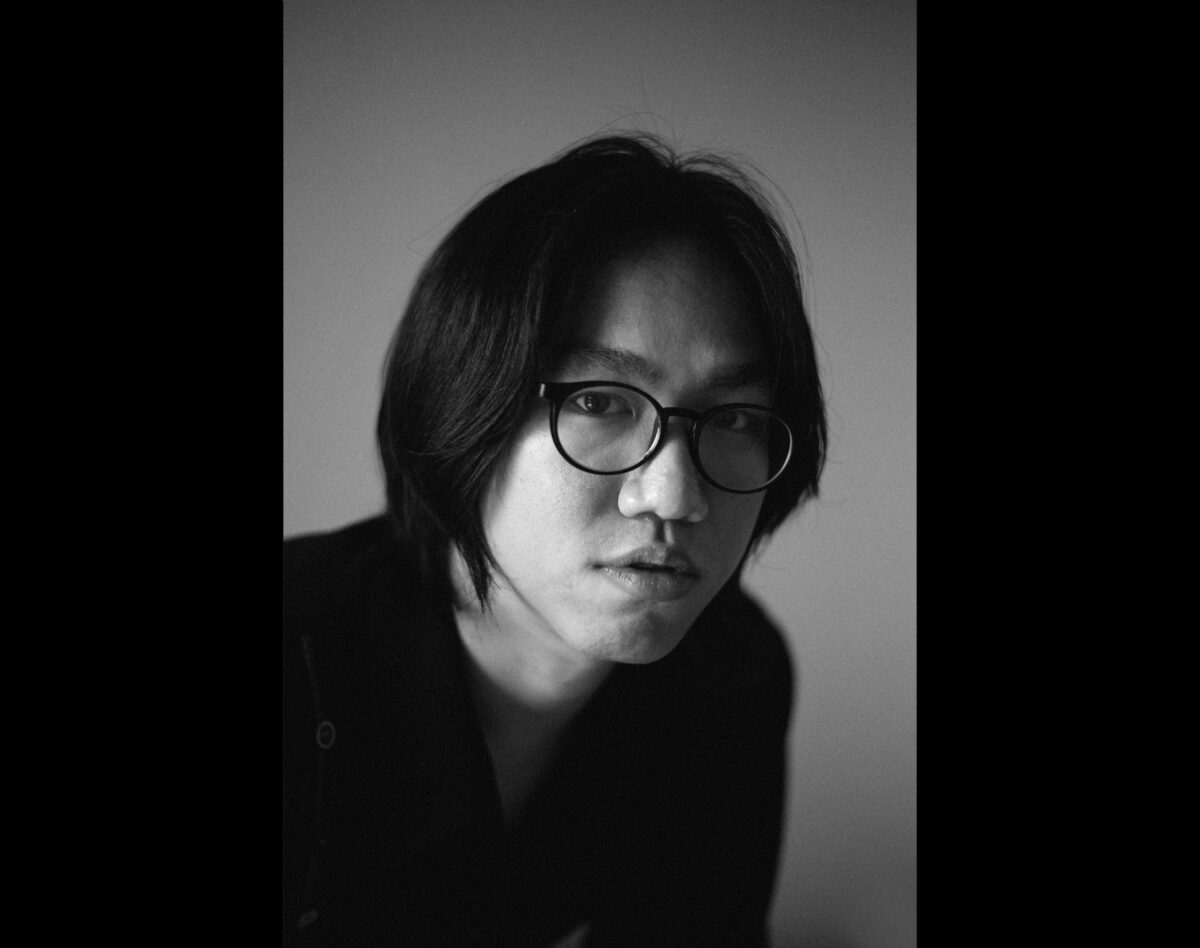
Eddie Htet Aung Lwyn (they/them), born in 1998 in Myanmar, have been in our residency programme Oslo Art Haven since June 2025. Eddie is a storyteller who works primarily with the languages of cinema and photography, though they identify first and foremost as a writer. Their work explores the complexities of gender and sexuality, as well as the transformation of identity through experimental storytelling.

Before 2021, Eddie gained experience working across various organizations and media platforms, including &Proud, a queer organization that celebrates LGBTQ+ lives and advocates for the decriminalization of homosexuality in Myanmar. In 2021, as the political situation in Myanmar deteriorated following the military coup, Eddie fled to Thailand with support from local organizations. They settled in Bangkok, where they began supporting newly arrived Burmese dissidents. They also worked as a researcher at Global Voices from the 2020 elections in Myanmar until 2023. 

I was doing all kinds of jobs in different organizations, researcher, translator, and more, because that was how I could justify leaving home while still feeling like I was contributing. I focused more on community work with other dissidents from Myanmar, as it felt more immediate and urgent. I put my creativity aside for as long as I could, until I no longer could. At the end of 2021, I quit most of my jobs to become a full-time artist, Eddie says. 

In 2022, Eddie created a photography project titled Weight, which explored themes of displacement, survivor’s guilt, the burden of political unrest, and their own identity crisis at the time. The project was a success and has been exhibited globally.

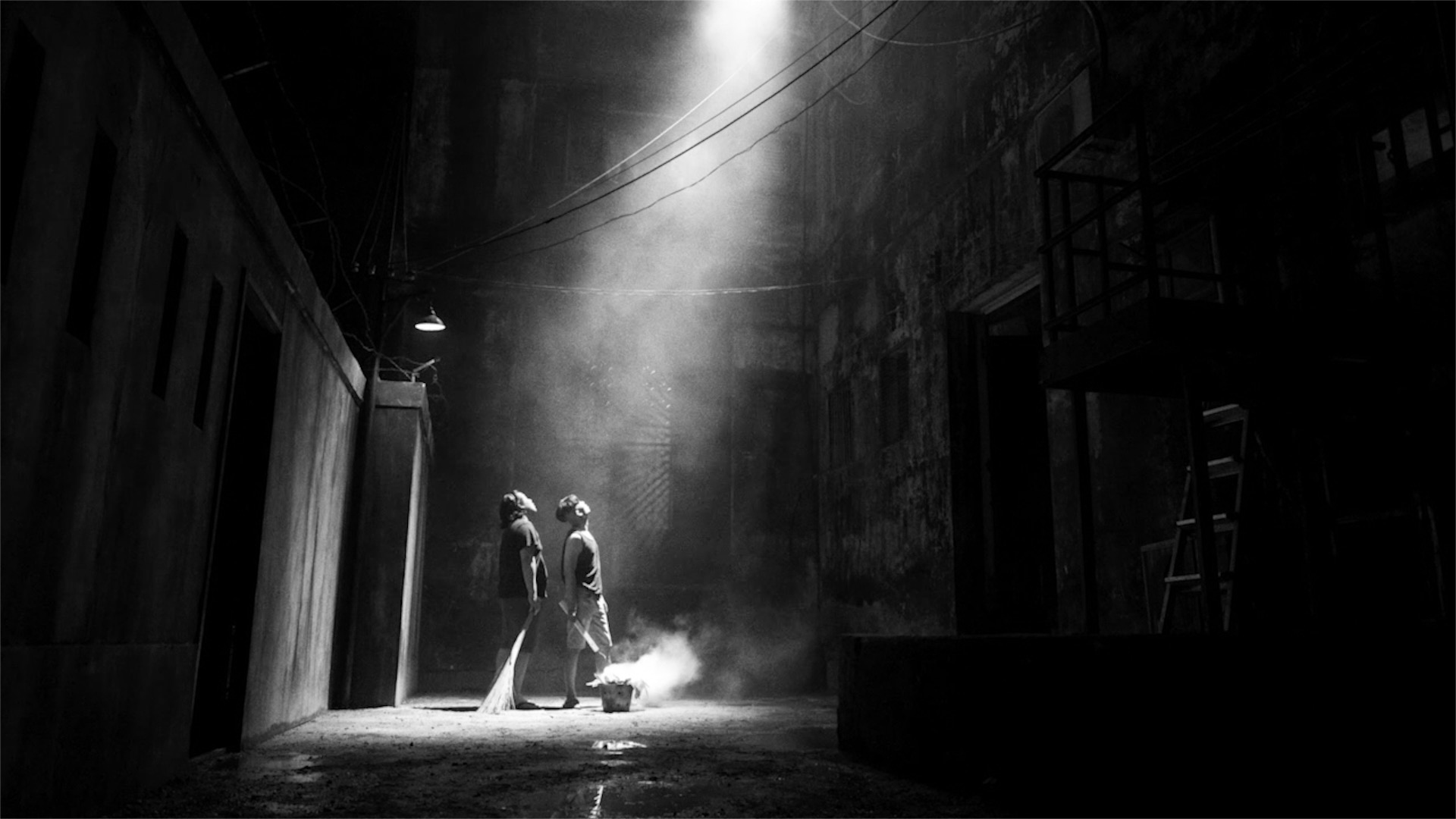
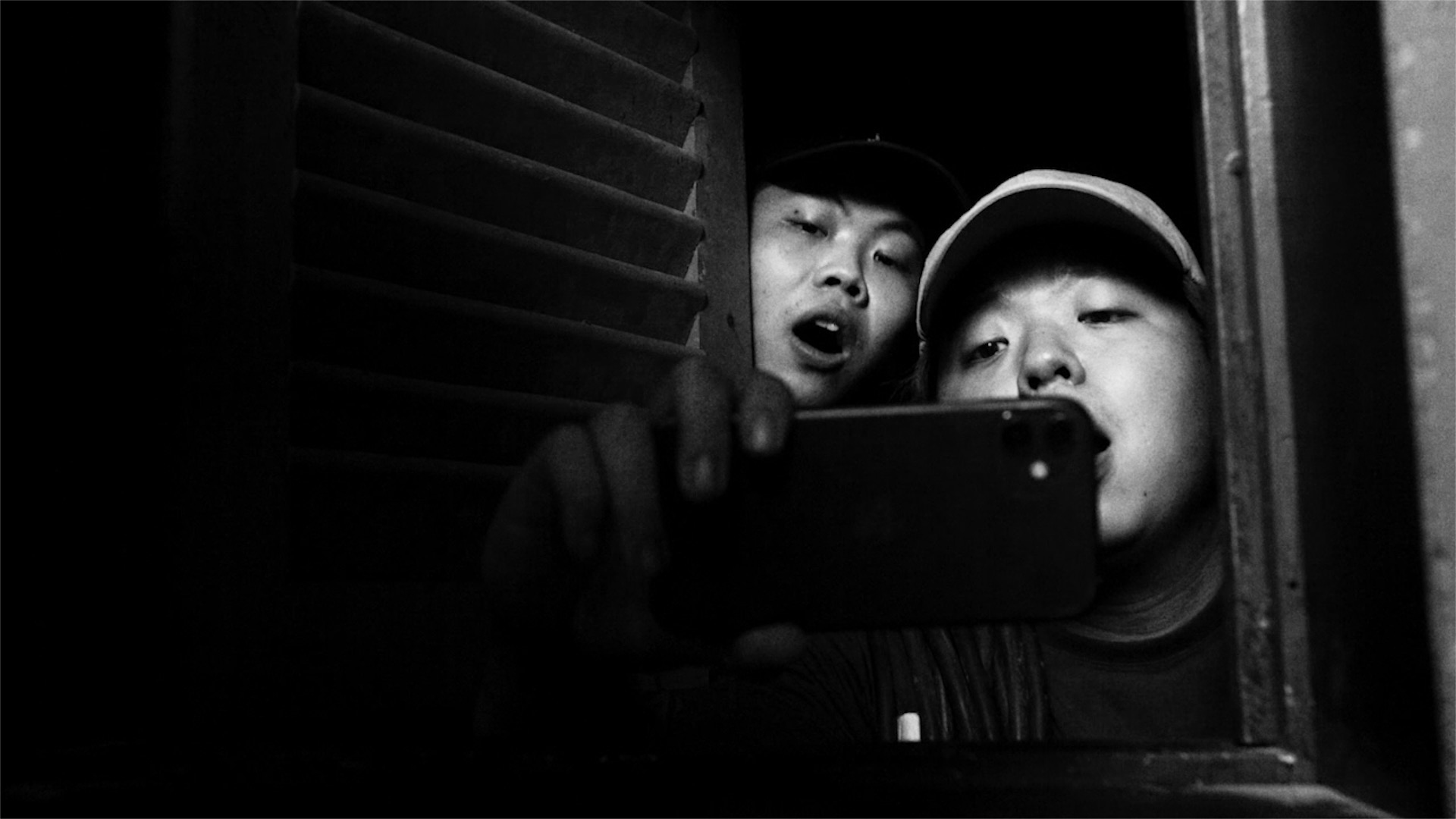
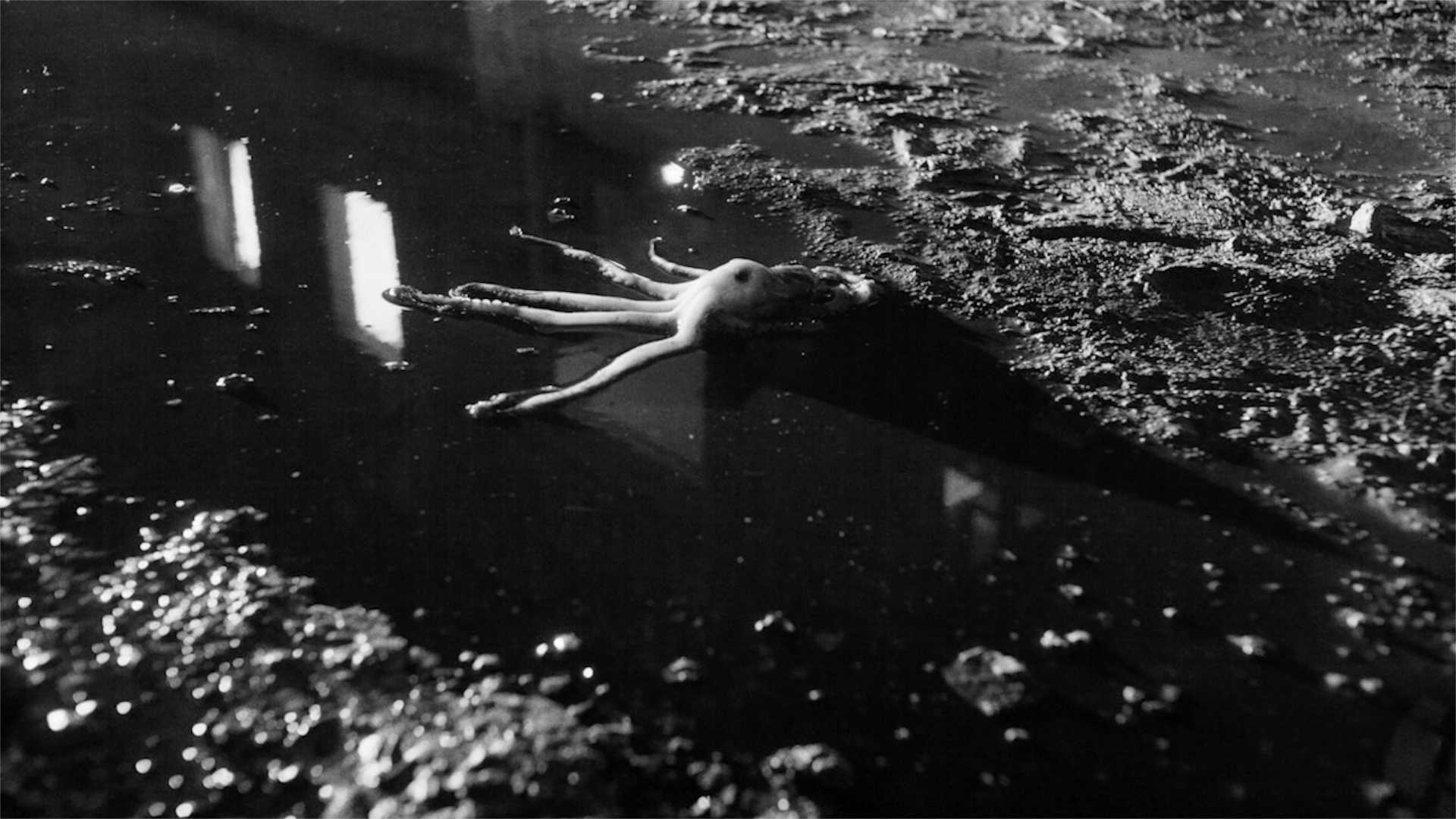
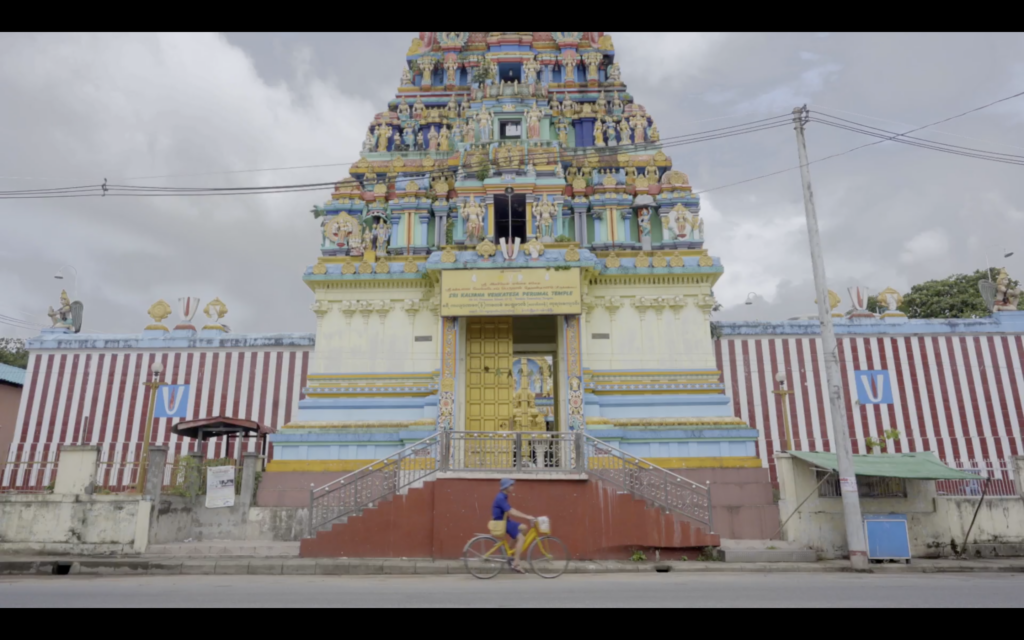
They have since completed three short films: Return to Sender (2020), Where the River Ends (2023), and JuJu vs.The Possibilities of Life, Love, and Death? (2024). These films have been screened internationally at different film festivals

Film still from Return to Sender (2020), dir. Eddie Htet Aung Lwyn (Photo: courtesy of the artist)

Telling Stories of Home From Afar

The stories in Eddie’s films are always set in Myanmar. However, since filming there is no longer possible, they are brought to life in Thailand. This raises a painful question: How does one create work about home while being forced to live away from it?

Eddie grew up in a community-oriented society, and being in a collective environment remains deeply important to them. Eddie would make a deliberate effort to involve Burmese people in their film crews, as many Burmese artists and filmmakers were also exiled to Thailand.

— When I am making a film, I am fully aware that it is not Myanmar, even though the story is set there. For example, in Where the River Ends, we filmed in a forest in Thailand. Because it was in a forest, it made us think: “This could be Myanmar, if we believed it.” That brought a sense of comfort. And that feeling only really came alive because we had Burmese people on the crew. I could hear the Burmese language around me all the time, and for a moment, it felt like home, Eddie recalls.

Film still from Where the River Ends (2023) dir. Eddie Htet Aung Lwyn (Photo: courtesy of the artist)

Leaving Home, Finding Self

In Myanmar, homosexuality and transgender remain criminalized under Section 377 of the Penal Code, a colonial-era law introduced by the British rule in the 19th century. Still in force today, it carries a punishment of up to 10 years in prison.

After leaving Myanmar, Eddie began to experience a sense of freedom from the country’s deeply homophobic policy and environment, but that freedom came at a cost, leaving behind the Burmese people, leaving home.

— It felt like two separate journeys happening simultaneously. Yes, I had to leave home; it was devastating, and living in exile carries a heavy burden of survivor’s guilt. But at the same time, I am finally able to dress how I want and be who I am as a queer person. Part of me feels liberated, safer, and freer. I am becoming a truer version of myself. And thankfully, along the way, I also found my community with other queer Burmese people in exile, Eddie says.

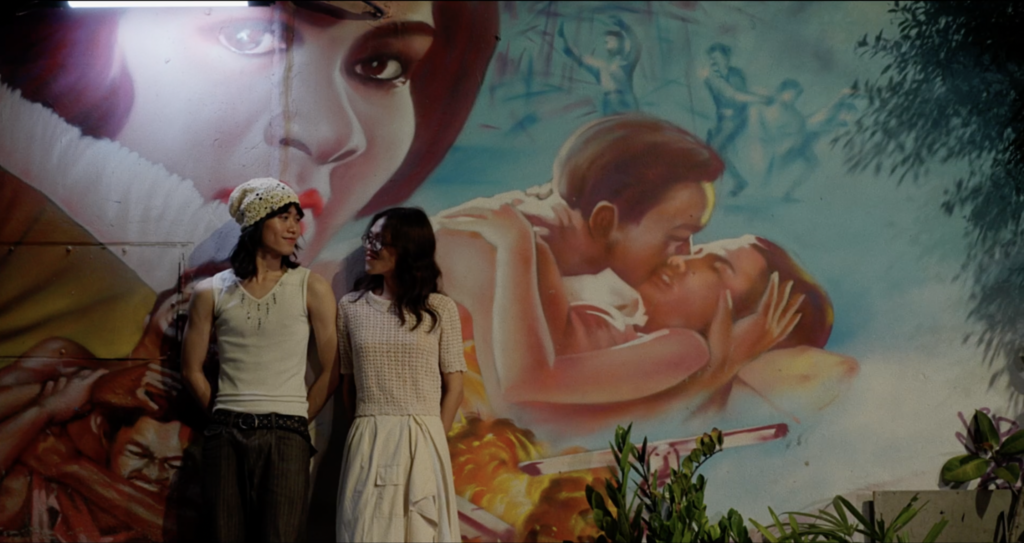
This dual experience of navigating identity, freedom, and belonging deeply informs Eddie’s work. For example In their film JuJu vs The Possibilities of Love, Life & Death? (2024). The story follows the protagonist JuJu, a Burmese trans femme working at an independent cinema in Bangkok. While there, she encounters another Burmese man, who may or may not have romantic feelings for her. What unfolds is a series of conversations and imagined scenarios in JuJu’s mind, exploring the power of queer representation in mainstream media, queer identity, stereotypes, and the search for love.

Film still from JuJu vs. The Possibilities of Life, Love, and Death? (2024) dir. Eddie Htet Aung Lwyn (Photo: courtesy of the artist)

New Film Project – Explores Privilege

Eddie said the calm of Oslo is much needed after four years of chaos in Bangkok. They want to use this opportunity to focus on researching and developing the script for their first feature-length film, a thriller set in the 1940s during British colonial rule in Myanmar.

This project explores the complexity of colonization and its dichotomy: between the local who remains oppressed, and the fellow Burmese who returns from abroad, now seen as an outsider. Eddie explains: 

— As one of the colonized, people are clearly oppressed, but within that, some start to see the colonizers as the model of ‘success.’ They start to learn their language, work with them, adopt their ways, and often get rewarded with privilege. In British-ruled Myanmar, many Burmese people worked alongside the British. They were given homes, education, and some were even sent abroad to study in England. My question is: does this make them less Burmese?

— While exploring this idea of privilege. I think about my own journey. My artistic career is, in part, ‘elevated’ because my people are being oppressed. If that weren’t the case, would anyone care what I have to say? Am I where I am because of my and my people’s trauma? I guess that is also one of the sources of my survivor’s guilt.

Freedom, Guilt, Heal

Feeling guilty is a complicated and often experienced emotion among exiled artists. Many carry a deep sense of guilt for being away from their homeland. For Eddie, this was no different. Does being an artist help ease survivor’s guilt, or does survivor’s guilt stem from being an exiled artist in the first place?

When Eddie first arrived in Thailand in 2021, survivor’s guilt became their main motivation for making art. It felt less like a choice and more like an urgent necessity. Eddie describes it as almost a physical response, like throwing up, an intense emotional release. They had no other choice but to make art to survive the heaviness they carried. That was when the photography project Weight was born.

— The survivor’s guilt is kind of the cause and the consequence. As an artist, I process my emotions through my art; that is how I cope with what is happening in the world. Guilt kind of pushed me forward. And frankly, in this industry, I would not be where I am without my guilt, because it was once my fuel to make work, Eddie reflects.

But now, Eddie seems to have found a new way to motivate their artistic practice, one rooted in acceptance and the celebration of community.

“Do I still feel survivor’s guilt? Yes, of course. But my motivation has shifted. Now, I want to create art as a celebration of being alive, of having survived, of being in community. I like to call it radical joy, because we all need it.

—  Eddie Htet Aung Lwyn 

From the photo series Weight, 2022 (photo: Eddie Htet Aung Lwyn)

When asked how to find one’s way through freedom, guilt, and healing, Eddie believes there is no simple answer, as it is an extremely complicated matter, and everyone’s situation is different.

— I wish there were a formula for how to navigate the dilemma of freedom and survivor’s guilt. But there isn’t. Everyone navigates the world in their own way. Some focus on building a career or financial stability, and that is valid; others may feel a strong desire to return home and contribute there, and that is valid, too. Because every experience is valid… Eddie shares.

Everyone navigates the world in their own unique way. We are all just doing the best we can with what we have.  
We all heal in our own time.

—  Eddie Htet Aung Lwyn 

Safemuse is looking forward to continuing our collaboration with Eddie and supporting their creative work during their residency with us.

© Safemuse Organisation - Oslo/Norway

Categories
News Project Safe Havens Safe Residencies

Saba Pouyeshman: Rewriting the spell, from supperssion to imagination


Saba Pouyeshman: Rewriting the spell, from suppression to imagination

July 8, 2025

Written by Kate Ngan Wa Ao

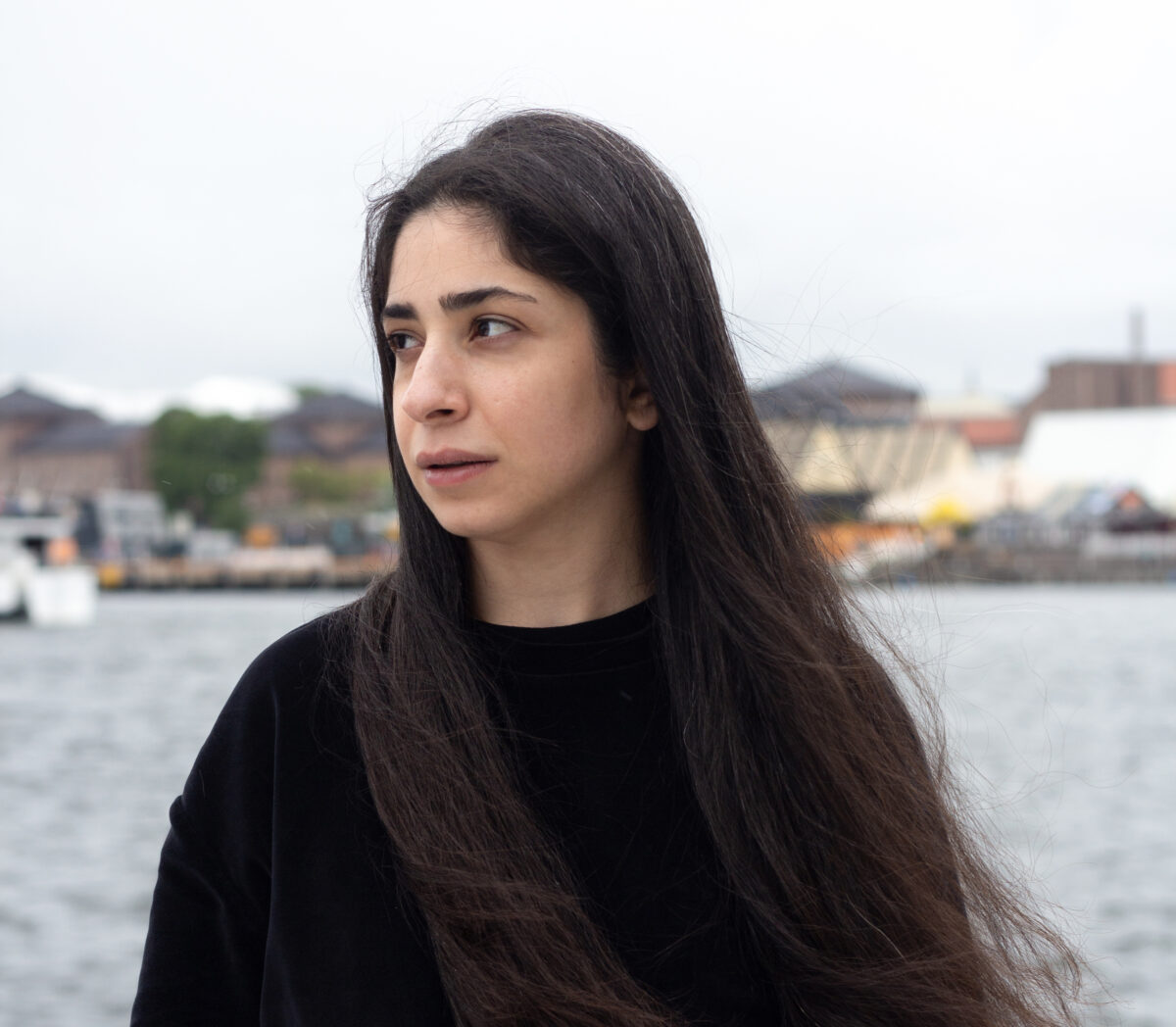
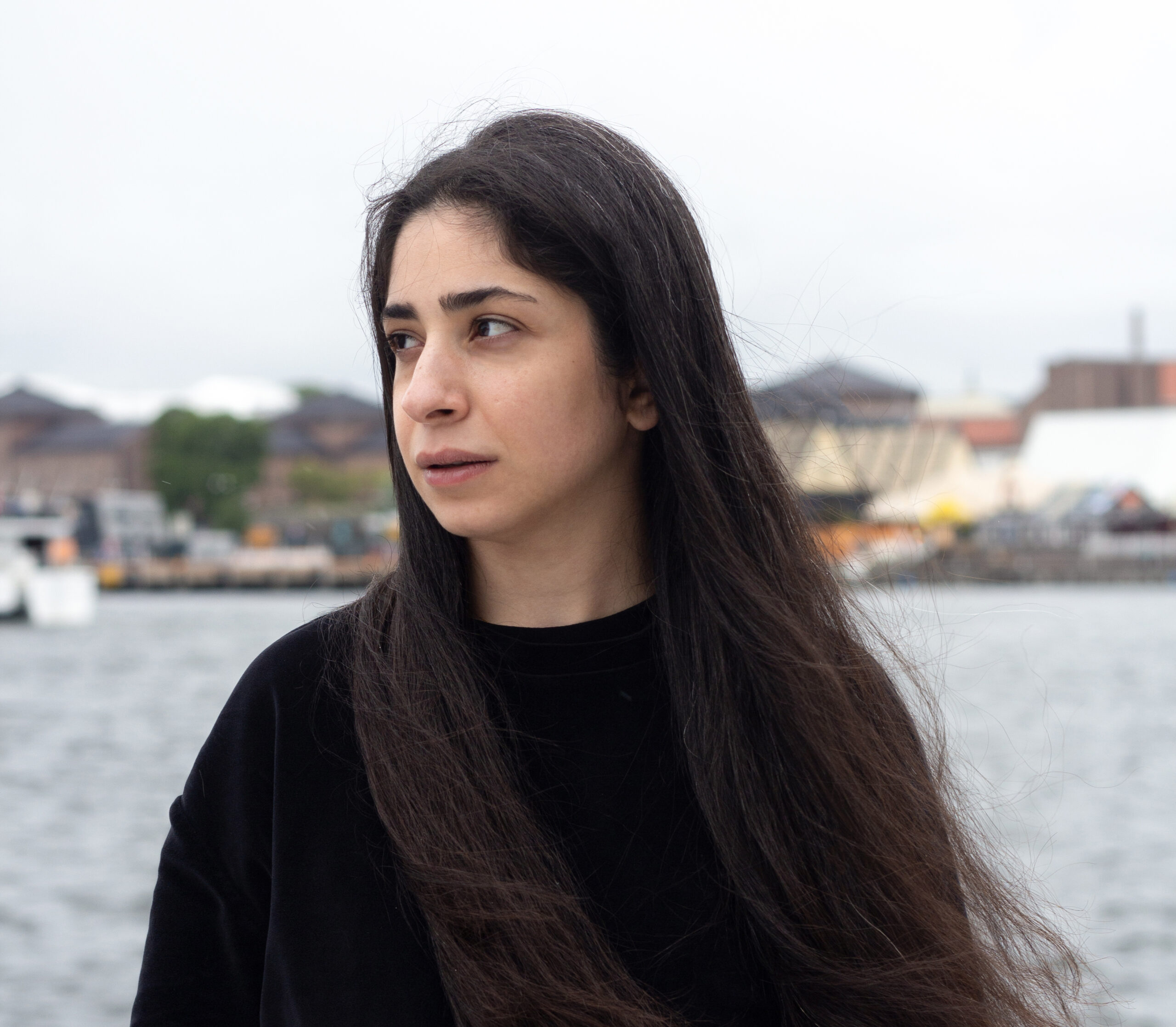
Saba Pouyeshman, multidisciplinary artist from Iran (Photo: Kate Ngan Wa Ao / Safemuse)

Saba Pouyeshman was born in Karaj, Iran, in 1997 and grew up in a large family. She discovered her passion for acting at a young age, often dressing up and improvising for hours, creating characters. Acting has been a way for her both to connect with the world and to disconnect from it when it becomes overwhelming; it creates a unique safe space for her.

Saba studied Cinema and Screenwriting at university in Iran, but her passion for acting never faded. She eventually pursued a career in theater. After working as an actress for nearly a decade, her journey was challenged by the harsh realities of censorship and the suppression of creative freedom. While working in Iranian theater, she experienced firsthand how freedom of expression was often manipulated as a tool of propaganda. Performance content and dress codes were strictly controlled, making it increasingly difficult for Saba to continue her work.

— When I was working in the theatre in Iran, I was often asked and forced to change my clothing not based on my character’s story, but solely to comply with the Islamic Republic’s strict dress codes, covering my hair and any exposed skin. I was constantly in conflict with myself while performing; I felt like a liar. The more I acted, the more suffocated I felt. Saba says.

— I developed a deep anger toward the endless, senseless limitations placed on artistic freedom. These obstacles not only affect individuals, but they also shape narratives, enforce propaganda in art, and destroy valuable cultural expression. I stepped away from acting, overwhelmed by depression. Saba recalls.

For a couple of years, I felt disconnected from all art forms. Being an artist under censorship and suppression often felt hopeless. But thankfully, art is more powerful than any dictatorship; it is part of what makes us human and cannot be silenced so easily. Slowly, the spark within me was reignited through a new artistic practice.

— Saba Pouyeshamn

Saba as an actress back in Iran in 2018 (Photo: published with the artist's permission)

Where Art Could Begin Again

Saba and another multidisciplinary Iranian artist, Pouya Pour-Amin, participated in Safemuse’s Safe Haven artistic residency program in Hvitsten in the spring of 2024 together, organised in collaboration with local partner Hvitsten Salong. Later, they spent the second part of their residency in Oslo, in collaboration with Nordic Black Theatre.

In Tehran, where she lived in an apartment surrounded by some hostile neighbours who supported the regime, Saba was under constant threat and anxiety, and was close to losing the strength to be an artist. But after moving to Hvitsten, she found herself inspired by the landscape and nature, and since then, she has spent nearly every drawing and painting.

From Tehran to Hvitsten, from a small, tense apartment to a beautiful house in the woods, right beside the fjord. From hostile, watchful neighbours to the amazing, open-hearted, and warm community of Hvitsten. This shift made me want to be bold and free in my art again. I was finally able to relax and create, says Saba.

—  Saba Pouyeshman 

Saba’s drawings were exhibited at Hvitsten Salong in 2024. The residency coordinator at Safemuse and the director of Hvitsten Salong, Jon Lundell, welcomed her and Pouya to their local community. He recalls:

— Saba, who has a multidisciplinary background, worked in several different art forms at Hvitsten Art Haven. She has a prominent role as an actress in the making of the play Prison Episodes together with Pouya Pouramin, and she has also been exploring and working more comprehensively with drawings.

— Both Saba and Pouya were a delight to have in Hvitsten! It is not always easy to come into a new reality in a small community like this, but their personalities, presence, warmth, and genuine interest in other people made it a simple joy to work with and facilitate.

Exhibition view of Saba’s drawing at Hvitsten Salong 2024 (Photo: Cronje Strøm / Hvitsten Salong)

Reborn in Dark Mytholog

After a temporary farewell to acting, Saba became interested in the theoretical side of art, particularly art history. She studied The History of Modern Art and The History of Modern Sculpture independently, and researched motifs in Iranian fabrics and pottery, as well as modern painting in Iran. These studies of visual traditions and symbolism, especially those rooted in mythology, have become the main inspiration for her artistic work now.

During her artist residency in Norway, Saba developed a new way to connect her past and present, merging performance and visual art into a distinctive practice. She once again dressed up as characters, but this time used her body and gestures not only as expressive tools, but also for mark-making, storytelling, and reclaiming her voice through the whole process of image-making.

— For example, in Fairy Invoker, I draw from Iranian folklore about the Fairy Caller, who traps fairies for good or bad purposes, some to save the world, others to destroy it. I imagine myself as one of these trapped fairies, each carrying different emotions and stories: fleeing, struggling, angry, calm, or meditative. I set up my camera to capture my movements and gestures as those fairies. Later, I drew the characters I once created and performed, Saba says.

— This is where my artistic practice lives, connected with storytelling, memories, and folklore. I want to explore what lies between reality and the supernatural; the visible and the invisible; the spoken and the unspoken. My performances are based on imagination, ancestral ghosts, childhood fears, and playful spirits. For me, life is aligned with magic, talismans, jinns, demons, fairies… Saba says.

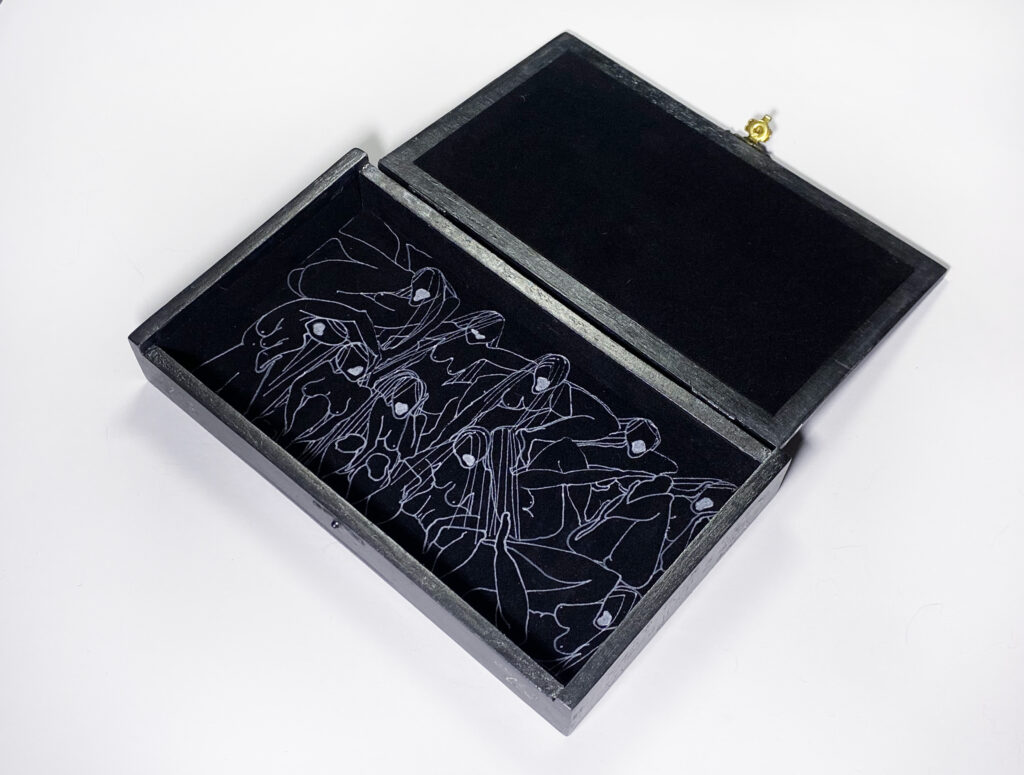
Saba Pouyeshman, Fairy Invoker, carved in a wooden box, 2025 (Photo: courtesy of the artist)
Saba Pouyeshman's sketches, 2025 (Photo: courtesy of the artist)

Myth, Wonder, and New Beginnings

Saba has many dreams to fulfill and continues to look forward. Now being in Norway, she is excited to learn more about Norse mythology, not just through books, but through the landscape, people, and living traditions. One of her artistic goals is to explore stories from the dark realms of mythology through different artistic media. She is deeply drawn to the mysterious, magical, and sometimes eerie elements of folklore and believes these stories hold powerful potential, not to frighten, but to inspire imagination, strength, and curiosity. Her goal is to create work that speaks to a raw and honest sense of wonder, inviting deeper questions and new ways of thinking.

— Mythological stories have the power to plant a seed of doubt, and I believe doubt is a beautiful and essential part of life. It’s often the first step toward thinking differently, asking deeper questions, and ultimately creating something new. Doubt opens the door to wonder, and through my art, I want to offer that door to others, says Saba.

Since July 2025, Saba has joined Safemuse as part of the Aspirant Scheme, a fellowship supported by Arts Council Norway. The programme will provide her with opportunities to gain experience in the arts and culture field, while also supporting her development as an artist. She will be working with Safemuse as well as other organisations and festivals, including Hvitsten Salong, Nordic Black Theatre, Empowering Voices, and JM Norway, with exciting possibilities for new collaborators to join along the way.

We are very much looking forward to continuing our collaboration with Saba and witnessing how she shares her magical spirit with the world.

© Safemuse Organisation - Oslo/Norway

Categories
News Project Safe Havens Safe Residencies

Pouya Pour-Amin: An artist’s journey from fear to freedom


Pouya Pour-Amin: An artist’s journey from fear to freedom

June 20, 2025

Written by Akari Izumi Kvamme

Pouya Pour-Amin is a multidisciplinary artist, born in Tehran and currently an artist-in-residence with Safemuse. (Photo: published with the artist's permission)

Pouya Pour-Amin is a multidisciplinary artist with over twenty years of experience in music, composition, sound design and performance. Born in Tehran in 1983 into a family that worked in the arts, Pouya grew up in a creative environment. His mother was a puppeteer and actress, his father was a cinematographer, and his grandfather was an instrumentalist who played the tar – a traditional Iranian string instrument. Pouya began learning music when he was five years old and by his late teens he was making his own music.

As a university student, he began to study computer science, music and theatre, but dropped out three times because he felt that the studies and academic system did not have much to offer him. He continued to study through self-learning and private teachers. Pouya played the guitar, but his love for the low frequencies led him to take up the double bass, which he coincidentally discovered while studying at the Tehran Conservatory. Later Pouya joined the contemporary chamber orchestra, The Camerada Orchestra, where he spent a decade of tremedous musical growth under the guidance the conductor Kayvan Mirhadi, who had also been his musical teacher. His very first works as a composer were performed by Mirhadi’s orchestra.

Looking back, Pouya’s grandfather, Akbar Jeddikar, and the conductor of the Camerada Orchestra, Kayvan Mirhadi, were his biggest inspirations growing up:

— They were both very special people to me, opened my eyes to the worlds of music and literature and became my window to the world beyond the strict religious Iranian society, he says.

— My grandfather first of all influenced me as a human being. He was not religious and did not believe in God, something which was very rare for his generation and in Iranian society in general. We had a very close relationship. He was open-minded and introduced me to politics and critical thought through his vast collection of literature. Kayvan Mirhadi, the conductor, was also my classical teacher, but did not have the dogma-point-of-view that most educators had. Instead he was wise and had an open view to the arts and to different kinds of music. He introduced me to Western contemporary music, which opened my eyes and made me realise that there was so much to explore and learn, Pouya recalls.

Pouya played the double bass for many years before beggining to explore new sounds and artistic disciplines. (Photo: published with the artist's permission)
“While living in Iran, I worked a lot in fear. I had to find secret ways, like put my phone in the microwave to avoid being tapped, and I lived under the constant fear of getting in trouble with the authorities.”

— Pouya Pour-Amin

The struggle for artistic freedom

Artists in Iran who refuse to stay silent in the face of the country’s authorities and current sociopolitical situation pay a high price for their expression. Over the last years, the Iranian government has taken on increasingly harsh measures to suppress artistic freedom of expression and exert control over artists through threats, censorship and persecution. 

Pouya laments the ongoing situation in his homecountry whereby artists, writers and journalists are frequently subjected to superveillance, interrogations, detention, imprisonment, torture, and even the death penalty to punish those who dare to question or criticise the system. Pouya has many friends and colleagues who have received death threats, been forced to flee the country and live in exile. He, too, has felt the heavy burden of being an artist without freedom of expression.

— While living in Iran, I worked a lot in fear. I had to find secret ways, like put my phone in the microwave, to avoid being tapped and I lived under the constant fear of getting in trouble with the authorities. Sometimes I chose not to put my name on my work to avoid getting in trouble. The thought that someone could call the door bell to detain me, plant evidence and present untrue allegations was constantly in the back of my mind, he says.

Pouya also worked with theatre, TV and cinema in Iran. (Photo: published with the artist's permission)

Pouya used to work with different people from various creative industries in Iran, but in his first act of conscious political reaction, he decided to stop working with TV and cinema because he felt like the cultural scene was corrupted and a channel for propagating the state’s lies. He began to work with theatre, but it became evident that this industry, too, was a corrupted sphere. In a culture where questioning and confronting was highly discouraged, Pouya  refused to be silenced and raised the question of why the industry did not pay its artists properly. After he took to the street and joined the marches during the Green Movement in 2010, Pouya was imprisoned twice. During the Woman, Life, Freedom movement in 2022, Pouya again took to the streets to partake in the demonstrations that were televised across the world, and felt the fear more than ever before.

— Artistic freedom for me is twenty years of struggling with propaganda, with censorship and a corrupted economy, he says. Even when you are independent, you are at risk if you want to raise questions about politics, the regime or religion, human rights. And it’s only getting worse and worse.

1st of May 2025: Pouya celebrates International Worker's Day for the very first time in by attending the annual parade in the streets of Oslo. - A long-awaited experience. (Photo: Akari Izumi Kvamme / Safemuse)
“To have artistic freedom now is a totally new feeling for me. I didn’t know how it would feel. When I look back at this short period I have worked in freedom, I can see that things have started changing in the ways that I think and create art.”

—  Pouya Pour-Amin

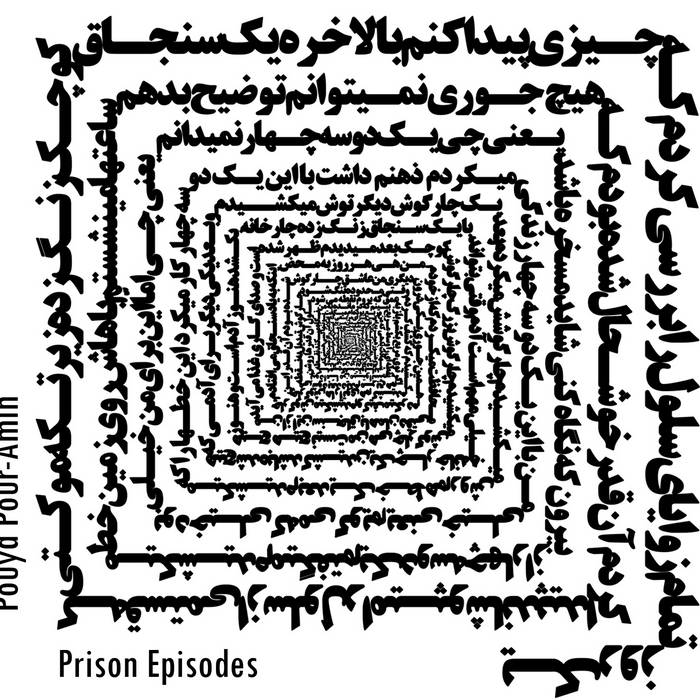
In 2019, Pouya released his second album, "Prisoners Episodes". He is currently working on a multidisciplinary performance about political prisoners' experiences and based on the music from. the album. The artwork for this album is by the prominent Iranian contemporary artist and grave marker Barbad Golshiri (Photo: published with the artist's permission)

From prison to Safe Haven and the rebirth of an artist

Since 2011, Pouya has expanded his work to include theatre, juggling the roles of musician, actor and director. His music has gradually transitioned into the more experimental and electronic realms. In May of 2024, he travelled to Norway to partake in Safemuse’s Safe Haven artistic residency program. The first part of his artistic residency was spent in the idyllic coastal town of Hvitsten, organised in collaborations with our local partner Hvitsten Salong. Thereafter, Pouya has spent the second part of his residency in Oslo, in collaboration with our partner Nordic Black Theatre.  

Through the Safe Haven program, Pouya has continued to evolve as a multidisciplinary artist and developing his creative practice through a blend of music, performance and theatre. Since arriving in Norway as an artist-in-residence, he has composed several works and performed at Ultimafestivalen – the largest contemporary music festival in the Nordic region, as well as Hvitsten Salong and at Caféteatret.

— When I arrived Norway and could breathe out after so many years of living in a state of exception and survival mode, I also realised that I was worn-out after having denied and neglected my own needs and wellbeing. I realised the constant fear I had been living under and how worn-out I was. Living in Hvitsten surrounded by beautiful nature, I was for the first time feeling everything I had not had the chance to feel prior to arriving Norway, especially related to my experience in prison and how hard it had actually been, Pouya says.

The residency coordinator in Safemuse Jon Lundell, is one of many that have worked with Pouya since his arrival to Norway and been impressed by his dedication, versatility and courage to explore new artistic directions:

Pouya have been exploring and digging deeper in composing new music for different scenes in Oslo and Hvitsten; commissioned work that has challenged him to seek new ways of composing and combining digital and analog instruments and sounds. He has also taken the work with his play Prison Episodes further and is developing it with different artists and partners.
In 2015, Pouya released his first album “Lullaby and Down the Quod” based on his own experience as a political prisoner. His second album, “Prison Episodes” (check out the Bandcamp link), which was released in 2019, was inspired by his study of other Iranian prisoners’ experiences. During his residency in Norway, Pouya’s main artistic ambition is to complete his project Prison Episodes which he has been developing over many years. Together with Safemuse, partners and other artists, Pouya is planning a multidisciplinary performance that combines music, dance, theatre and visual technology to tell the story of the tragedy of political prisoners and their subjection to torture, suffering, solicitations and death. On top of that, he has also begun to record a new album, which he hopes to release in 2026.
Pouya says he has learned a lot of things through the Safemuse residency, not just artistically, but about life and himself:

— I love my culture and I cannot cut that string, but now I am in a position to decide how I want to work with it and to tell my story. To have artistic freedom now is a totally new feeling for me. I didn’t know how it would feel. When I look back at this short period I have worked in freedom, I can see that things have started changing in the ways that I think and create art. When you no longer have barriers in your mind, you starts to think differently and your passions start changing. With no imposed limitations, I think my artistic language has already started to change. I feel like the blinds are gone. While I have been working on my newest album, I can see that I am going in new directions that I would never have imagined before.

Safemuse looks forward to continue the collaboration with Pouya and share more about his upcoming events and projects!

Safemuse organisation Norway
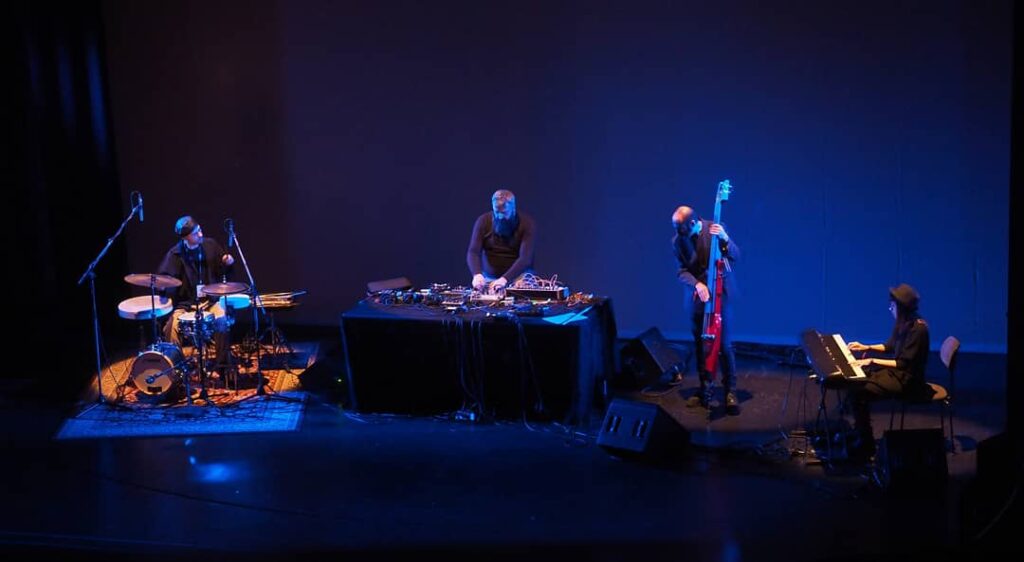
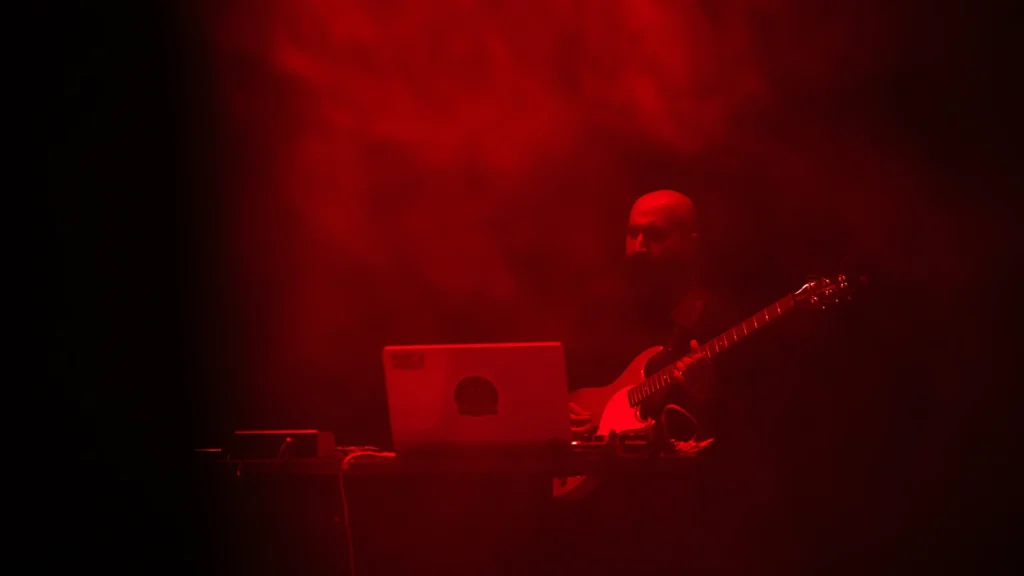
In September 2024, Pouya was invited to perform at Trekanten in Oslo, during Ultimafestivalen, the largest contemporary music festival in the Nordic region. (Photo: Nabeeh Samaan / Ultimafestivalen)
Vi stenger døren for dem som forsvarer menneskerettighetene

Menu Close Safemuse About Us What we do Our five pillars Our history Who we are Our members Media resources Contact Us News Safe residencies Residency programme Oslo Art Haven Hvitsten Art Haven How to apply Projects Safe Havens Conference Women’s network MoFA+ collaboration Salong på Salongen Artistic mobility Artistic Freedom Week LIDIO .SAFE Artists

About Us What we do Our five pillars Our history Who we are Our members Media resources Contact Us News Safe residencies Residency programme Oslo Art Haven Hvitsten Art Haven How to apply Projects Safe Havens Conference Women’s network MoFA+ collaboration Salong på Salongen Artistic mobility Artistic Freedom Week LIDIO .SAFE Artists

About Us What we do Our five pillars Our history Who we are Our members Media resources Contact Us News Safe residencies Residency programme Oslo Art Haven Hvitsten Art Haven How to apply Projects Safe Havens Conference Women’s network MoFA+ collaboration Salong på Salongen Artistic mobility Artistic Freedom Week LIDIO .SAFE Artists ...

Exhibition – Art Captures

Menu Close Safemuse About Us What we do Our five pillars Our history Who we are Our members Media resources Contact Us News Safe residencies Residency programme Oslo Art Haven Hvitsten Art Haven How to apply Projects Safe Havens Conference Women’s network MoFA+ collaboration Salong på Salongen Artistic mobility Artistic Freedom Week LIDIO .SAFE Artists

About Us What we do Our five pillars Our history Who we are Our members Media resources Contact Us News Safe residencies Residency programme Oslo Art Haven Hvitsten Art Haven How to apply Projects Safe Havens Conference Women’s network MoFA+ collaboration Salong på Salongen Artistic mobility Artistic Freedom Week LIDIO .SAFE Artists

About Us What we do Our five pillars Our history Who we are Our members Media resources Contact Us News Safe residencies Residency programme Oslo Art Haven Hvitsten Art Haven How to apply Projects Safe Havens Conference Women’s network MoFA+ collaboration Salong på Salongen Artistic mobility Artistic Freedom Week LIDIO .SAFE Artists ...

Ytringsfrihet i teori og praksis – den oversette kunstneren

Menu Close Safemuse About Us What we do Our five pillars Our history Who we are Our members Media resources Contact Us News Safe residencies Residency programme Oslo Art Haven Hvitsten Art Haven How to apply Projects Safe Havens Conference Women’s network MoFA+ collaboration Salong på Salongen Artistic mobility Artistic Freedom Week LIDIO .SAFE Artists

About Us What we do Our five pillars Our history Who we are Our members Media resources Contact Us News Safe residencies Residency programme Oslo Art Haven Hvitsten Art Haven How to apply Projects Safe Havens Conference Women’s network MoFA+ collaboration Salong på Salongen Artistic mobility Artistic Freedom Week LIDIO .SAFE Artists

About Us What we do Our five pillars Our history Who we are Our members Media resources Contact Us News Safe residencies Residency programme Oslo Art Haven Hvitsten Art Haven How to apply Projects Safe Havens Conference Women’s network MoFA+ collaboration Salong på Salongen Artistic mobility Artistic Freedom Week LIDIO .SAFE Artists ...

Nurperi Orunbaeva: Decolonising the Self through Artistic Practice and Reimagining Ancestral Heritage

Menu Close Safemuse About Us What we do Our five pillars Our history Who we are Our members Media resources Contact Us News Safe residencies Residency programme Oslo Art Haven Hvitsten Art Haven How to apply Projects Safe Havens Conference Women’s network MoFA+ collaboration Salong på Salongen Artistic mobility Artistic Freedom Week LIDIO .SAFE Artists

About Us What we do Our five pillars Our history Who we are Our members Media resources Contact Us News Safe residencies Residency programme Oslo Art Haven Hvitsten Art Haven How to apply Projects Safe Havens Conference Women’s network MoFA+ collaboration Salong på Salongen Artistic mobility Artistic Freedom Week LIDIO .SAFE Artists

About Us What we do Our five pillars Our history Who we are Our members Media resources Contact Us News Safe residencies Residency programme Oslo Art Haven Hvitsten Art Haven How to apply Projects Safe Havens Conference Women’s network MoFA+ collaboration Salong på Salongen Artistic mobility Artistic Freedom Week LIDIO .SAFE Artists ...

Burmese queer film dispatch

Menu Close Safemuse About Us What we do Our five pillars Our history Who we are Our members Media resources Contact Us News Safe residencies Residency programme Oslo Art Haven Hvitsten Art Haven How to apply Projects Safe Havens Conference Women’s network MoFA+ collaboration Salong på Salongen Artistic mobility Artistic Freedom Week LIDIO .SAFE Artists

About Us What we do Our five pillars Our history Who we are Our members Media resources Contact Us News Safe residencies Residency programme Oslo Art Haven Hvitsten Art Haven How to apply Projects Safe Havens Conference Women’s network MoFA+ collaboration Salong på Salongen Artistic mobility Artistic Freedom Week LIDIO .SAFE Artists

About Us What we do Our five pillars Our history Who we are Our members Media resources Contact Us News Safe residencies Residency programme Oslo Art Haven Hvitsten Art Haven How to apply Projects Safe Havens Conference Women’s network MoFA+ collaboration Salong på Salongen Artistic mobility Artistic Freedom Week LIDIO .SAFE Artists ...

Eddie Htet Aung Lwyn: A Dose of Survivor’s Guilt, Recurrent Frustration, and Moments of Overcoming

Menu Close Safemuse About Us What we do Our five pillars Our history Who we are Our members Media resources Contact Us News Safe residencies Residency programme Oslo Art Haven Hvitsten Art Haven How to apply Projects Safe Havens Conference Women’s network MoFA+ collaboration Salong på Salongen Artistic mobility Artistic Freedom Week LIDIO .SAFE Artists

About Us What we do Our five pillars Our history Who we are Our members Media resources Contact Us News Safe residencies Residency programme Oslo Art Haven Hvitsten Art Haven How to apply Projects Safe Havens Conference Women’s network MoFA+ collaboration Salong på Salongen Artistic mobility Artistic Freedom Week LIDIO .SAFE Artists

About Us What we do Our five pillars Our history Who we are Our members Media resources Contact Us News Safe residencies Residency programme Oslo Art Haven Hvitsten Art Haven How to apply Projects Safe Havens Conference Women’s network MoFA+ collaboration Salong på Salongen Artistic mobility Artistic Freedom Week LIDIO .SAFE Artists ...

Saba Pouyeshman: Rewriting the spell, from supperssion to imagination

Menu Close Safemuse About Us What we do Our five pillars Our history Who we are Our members Media resources Contact Us News Safe residencies Residency programme Oslo Art Haven Hvitsten Art Haven How to apply Projects Safe Havens Conference Women’s network MoFA+ collaboration Salong på Salongen Artistic mobility Artistic Freedom Week LIDIO .SAFE Artists

About Us What we do Our five pillars Our history Who we are Our members Media resources Contact Us News Safe residencies Residency programme Oslo Art Haven Hvitsten Art Haven How to apply Projects Safe Havens Conference Women’s network MoFA+ collaboration Salong på Salongen Artistic mobility Artistic Freedom Week LIDIO .SAFE Artists

About Us What we do Our five pillars Our history Who we are Our members Media resources Contact Us News Safe residencies Residency programme Oslo Art Haven Hvitsten Art Haven How to apply Projects Safe Havens Conference Women’s network MoFA+ collaboration Salong på Salongen Artistic mobility Artistic Freedom Week LIDIO .SAFE Artists ...

Pouya Pour-Amin: An artist’s journey from fear to freedom

Menu Close Safemuse About Us What we do Our five pillars Our history Who we are Our members Media resources Contact Us News Safe residencies Residency programme Oslo Art Haven Hvitsten Art Haven How to apply Projects Safe Havens Conference Women’s network MoFA+ collaboration Salong på Salongen Artistic mobility Artistic Freedom Week LIDIO .SAFE Artists

About Us What we do Our five pillars Our history Who we are Our members Media resources Contact Us News Safe residencies Residency programme Oslo Art Haven Hvitsten Art Haven How to apply Projects Safe Havens Conference Women’s network MoFA+ collaboration Salong på Salongen Artistic mobility Artistic Freedom Week LIDIO .SAFE Artists

About Us What we do Our five pillars Our history Who we are Our members Media resources Contact Us News Safe residencies Residency programme Oslo Art Haven Hvitsten Art Haven How to apply Projects Safe Havens Conference Women’s network MoFA+ collaboration Salong på Salongen Artistic mobility Artistic Freedom Week LIDIO .SAFE Artists ...

Meet our newest staff members

Menu Close Safemuse About Us What we do Our five pillars Our history Who we are Our members Media resources Contact Us News Safe residencies Residency programme Oslo Art Haven Hvitsten Art Haven How to apply Projects Safe Havens Conference Women’s network MoFA+ collaboration Salong på Salongen Artistic mobility Artistic Freedom Week LIDIO .SAFE Artists

About Us What we do Our five pillars Our history Who we are Our members Media resources Contact Us News Safe residencies Residency programme Oslo Art Haven Hvitsten Art Haven How to apply Projects Safe Havens Conference Women’s network MoFA+ collaboration Salong på Salongen Artistic mobility Artistic Freedom Week LIDIO .SAFE Artists

About Us What we do Our five pillars Our history Who we are Our members Media resources Contact Us News Safe residencies Residency programme Oslo Art Haven Hvitsten Art Haven How to apply Projects Safe Havens Conference Women’s network MoFA+ collaboration Salong på Salongen Artistic mobility Artistic Freedom Week LIDIO .SAFE Artists ...

Meet our newest staff member

Menu Close Safemuse About Us What we do Our five pillars Our history Who we are Our members Media resources Contact Us News Safe residencies Residency programme Oslo Art Haven Hvitsten Art Haven How to apply Projects Safe Havens Conference Women’s network MoFA+ collaboration Salong på Salongen Artistic mobility Artistic Freedom Week LIDIO .SAFE Artists

About Us What we do Our five pillars Our history Who we are Our members Media resources Contact Us News Safe residencies Residency programme Oslo Art Haven Hvitsten Art Haven How to apply Projects Safe Havens Conference Women’s network MoFA+ collaboration Salong på Salongen Artistic mobility Artistic Freedom Week LIDIO .SAFE Artists

About Us What we do Our five pillars Our history Who we are Our members Media resources Contact Us News Safe residencies Residency programme Oslo Art Haven Hvitsten Art Haven How to apply Projects Safe Havens Conference Women’s network MoFA+ collaboration Salong på Salongen Artistic mobility Artistic Freedom Week LIDIO .SAFE Artists ...

© Safemuse Organisation - Oslo/Norway

Categories
Administration News Project

Safemuse søker programmedarbeider

Safemuse søker programmedarbeider

February 28, 2025

Photo Description - Photo credit: Photographer name

Meningsfylt arbeid med spennende og varierte oppgaver i et internasjonalt miljø

Da vår kollega skal ut i permisjon søker vi en fleksibel, engasjert, selvgående medarbeider med gode samarbeidsevner i 100% stilling til et ettårig engasjement, med mulighet for forlengelse fra mai/juni 2025.

I våre faste residenser tar vi imot truede, forfulgte og sensurerte kunstnere og følger dem opp både faglig og personlig. Vi skal bidra til at kunstnerne i residensopphold får forutsigbare og gode arbeidsforhold, og får utviklet og presentert sin kunst. I tillegg har vi flere prosjekter knyttet til kunstnerisk ytringsfrihet. Programmedarbeideren skal bidra i våre ulike prosjekter og til utviklingen av residensprogrammet med visninger, samtaler, workshops, konserter og forestillinger for barn og unge og det generelle publikum. Enkelte kommunikasjons- og administrasjonsoppgaver vil også inngå i stillingen. Man må påberegne ansvar også for andre oppgaver etter behov.

Vi ønsker oss en kollega som kan utgjøre et positivt tilskudd til innsatsen vår for den kunstneriske ytringsfriheten. Vi er en liten administrasjon med et aktivt styre der det er stor plass for kreativitet og nye løsninger. Vår aktivitet omfatter trygge residenser for kunstnere, enkeltarrangementer, kunstneriske visninger, innspillinger og dokumentasjon, politisk påvirkningsarbeid, samt annet som kan bidra til å styrke den kunstneriske ytringsfriheten for enkeltkunstnere og i samfunnet for øvrig. Å sørge for finansiering til dette er en vesentlig del av vårt arbeid.

Personen vi søker har bakgrunn fra kunstfeltet og har et engasjement for ytringsfrihet, menneskerettigheter og internasjonale forhold. Vi vektlegger også internasjonal erfaring.

Det er viktig at vår nye medarbeider har en forståelse for fleksibiliteten som kreves når man driver residens og kan håndtere uventede situasjoner og endringer på en god måte. Personen vi ansetter må kunne arbeide godt i team og være lydhør og tillitsskapende i møtet med kunstnere fra svært ulike bakgrunner og forskjellige land. Fleksibilitet og forståelse i møte med kunstnere fra alle deler av verden og resten av teamet er essensielt.

Du bør ha solid formuleringsevne på norsk og engelsk, både muntlig og skriftlig.


Programmedarbeiders oppgaver inkluderer, men er ikke begrenset til

  • Bidra inn til residensene praktisk og kunstfaglig
  • Bidra til utvikling av vårt kunst- og samfunnsprogram gjennom workshops for kunstnere, samtaler, visninger og konserter rettet mot et bredere publikum.
  • Fasilitere produksjon av kunst i ulike former med våre samarbeidspartnere
  • Bidra til å skape, tilrettelegge og utvikle visninger og konserter i samarbeid med residenskunstneren, residenskoordinator og andre prosjektdeltakere
  • Rapportering, budsjett og søknader knyttet til ansvarsområdet
  • Knytte kunstneren opp mot faglig nettverk.
  • Administrasjon

Bakgrunn og kvalifikasjoner

  • Bred kunstfaglig bakgrunn, Kunstfaglig kompetanse og/eller erfaring gjennom feks eget kunstnerisk virke eller gjennom å kuratere, organisere eller produserer kunstfaglige eller kunstneriske prosjekter.
  • Stort nettverk i norsk kunst og kulturliv
  • Internasjonal erfaring er en fordel, har du bakgrunn fra, har bodd eller arbeidet i et annet land er det en fordel
  • Interesse for menneskerettigheter og kunstnerisk ytringsfrihet
  • Erfaring med arrangementsutvikling, workshops eller kuratering/kunstproduksjon/visninger/scenearbeid
  • Erfaring med søknadsskriving og ryddig og nøyaktig rapportering skriftlig og muntlig
  • Ha solid formuleringsevne på norsk og engelsk, både muntlig og skriftlig

Personlige egenskaper

  • Du har en god forståelse av fleksibilitet
  • God sosial, kulturell og kunstnerisk kompetanse
  • Selvgående, men også en lagspiller
  • Kreativ og lyttende med gjennomføringsevne
  • Evne til å skape positivt engasjement
  • Forståelse for kunstneriske prosesser

Personlig egnethet og teamets totale sammensetning vil bli vektlagt.


Vi tilbyr:

Stillingsstørrelse: 100%

Lønn etter avtale.

Fleksibel arbeidstid etter avtale.

En del reisevirksomhet samt arbeid kvelder og helger må påregnes.

Safemuse holder til i kontor i Oscarsgate i Oslo og driver også residens i Hvitsten i Vestby kommune.  

SØKNADSFRIST 16.mars

Innkomne søknader vurderes fortløpende.

Søknad med referanser og CV sendes celina@safemuse.org

Kontaktperson: Daglig leder Celina Jerman Bright-Taylor, telefon 95735598

Vi stenger døren for dem som forsvarer menneskerettighetene

Menu Close Safemuse About Us What we do Our five pillars Our history Who we are Our members Media resources Contact Us News Safe residencies Residency programme Oslo Art Haven Hvitsten Art Haven How to apply Projects Safe Havens Conference Women’s network MoFA+ collaboration Salong på Salongen Artistic mobility Artistic Freedom Week LIDIO .SAFE Artists

About Us What we do Our five pillars Our history Who we are Our members Media resources Contact Us News Safe residencies Residency programme Oslo Art Haven Hvitsten Art Haven How to apply Projects Safe Havens Conference Women’s network MoFA+ collaboration Salong på Salongen Artistic mobility Artistic Freedom Week LIDIO .SAFE Artists

About Us What we do Our five pillars Our history Who we are Our members Media resources Contact Us News Safe residencies Residency programme Oslo Art Haven Hvitsten Art Haven How to apply Projects Safe Havens Conference Women’s network MoFA+ collaboration Salong på Salongen Artistic mobility Artistic Freedom Week LIDIO .SAFE Artists ...

Exhibition – Art Captures

Menu Close Safemuse About Us What we do Our five pillars Our history Who we are Our members Media resources Contact Us News Safe residencies Residency programme Oslo Art Haven Hvitsten Art Haven How to apply Projects Safe Havens Conference Women’s network MoFA+ collaboration Salong på Salongen Artistic mobility Artistic Freedom Week LIDIO .SAFE Artists

About Us What we do Our five pillars Our history Who we are Our members Media resources Contact Us News Safe residencies Residency programme Oslo Art Haven Hvitsten Art Haven How to apply Projects Safe Havens Conference Women’s network MoFA+ collaboration Salong på Salongen Artistic mobility Artistic Freedom Week LIDIO .SAFE Artists

About Us What we do Our five pillars Our history Who we are Our members Media resources Contact Us News Safe residencies Residency programme Oslo Art Haven Hvitsten Art Haven How to apply Projects Safe Havens Conference Women’s network MoFA+ collaboration Salong på Salongen Artistic mobility Artistic Freedom Week LIDIO .SAFE Artists ...

Ytringsfrihet i teori og praksis – den oversette kunstneren

Menu Close Safemuse About Us What we do Our five pillars Our history Who we are Our members Media resources Contact Us News Safe residencies Residency programme Oslo Art Haven Hvitsten Art Haven How to apply Projects Safe Havens Conference Women’s network MoFA+ collaboration Salong på Salongen Artistic mobility Artistic Freedom Week LIDIO .SAFE Artists

About Us What we do Our five pillars Our history Who we are Our members Media resources Contact Us News Safe residencies Residency programme Oslo Art Haven Hvitsten Art Haven How to apply Projects Safe Havens Conference Women’s network MoFA+ collaboration Salong på Salongen Artistic mobility Artistic Freedom Week LIDIO .SAFE Artists

About Us What we do Our five pillars Our history Who we are Our members Media resources Contact Us News Safe residencies Residency programme Oslo Art Haven Hvitsten Art Haven How to apply Projects Safe Havens Conference Women’s network MoFA+ collaboration Salong på Salongen Artistic mobility Artistic Freedom Week LIDIO .SAFE Artists ...

Nurperi Orunbaeva: Decolonising the Self through Artistic Practice and Reimagining Ancestral Heritage

Menu Close Safemuse About Us What we do Our five pillars Our history Who we are Our members Media resources Contact Us News Safe residencies Residency programme Oslo Art Haven Hvitsten Art Haven How to apply Projects Safe Havens Conference Women’s network MoFA+ collaboration Salong på Salongen Artistic mobility Artistic Freedom Week LIDIO .SAFE Artists

About Us What we do Our five pillars Our history Who we are Our members Media resources Contact Us News Safe residencies Residency programme Oslo Art Haven Hvitsten Art Haven How to apply Projects Safe Havens Conference Women’s network MoFA+ collaboration Salong på Salongen Artistic mobility Artistic Freedom Week LIDIO .SAFE Artists

About Us What we do Our five pillars Our history Who we are Our members Media resources Contact Us News Safe residencies Residency programme Oslo Art Haven Hvitsten Art Haven How to apply Projects Safe Havens Conference Women’s network MoFA+ collaboration Salong på Salongen Artistic mobility Artistic Freedom Week LIDIO .SAFE Artists ...

Burmese queer film dispatch

Menu Close Safemuse About Us What we do Our five pillars Our history Who we are Our members Media resources Contact Us News Safe residencies Residency programme Oslo Art Haven Hvitsten Art Haven How to apply Projects Safe Havens Conference Women’s network MoFA+ collaboration Salong på Salongen Artistic mobility Artistic Freedom Week LIDIO .SAFE Artists

About Us What we do Our five pillars Our history Who we are Our members Media resources Contact Us News Safe residencies Residency programme Oslo Art Haven Hvitsten Art Haven How to apply Projects Safe Havens Conference Women’s network MoFA+ collaboration Salong på Salongen Artistic mobility Artistic Freedom Week LIDIO .SAFE Artists

About Us What we do Our five pillars Our history Who we are Our members Media resources Contact Us News Safe residencies Residency programme Oslo Art Haven Hvitsten Art Haven How to apply Projects Safe Havens Conference Women’s network MoFA+ collaboration Salong på Salongen Artistic mobility Artistic Freedom Week LIDIO .SAFE Artists ...

Eddie Htet Aung Lwyn: A Dose of Survivor’s Guilt, Recurrent Frustration, and Moments of Overcoming

Menu Close Safemuse About Us What we do Our five pillars Our history Who we are Our members Media resources Contact Us News Safe residencies Residency programme Oslo Art Haven Hvitsten Art Haven How to apply Projects Safe Havens Conference Women’s network MoFA+ collaboration Salong på Salongen Artistic mobility Artistic Freedom Week LIDIO .SAFE Artists

About Us What we do Our five pillars Our history Who we are Our members Media resources Contact Us News Safe residencies Residency programme Oslo Art Haven Hvitsten Art Haven How to apply Projects Safe Havens Conference Women’s network MoFA+ collaboration Salong på Salongen Artistic mobility Artistic Freedom Week LIDIO .SAFE Artists

About Us What we do Our five pillars Our history Who we are Our members Media resources Contact Us News Safe residencies Residency programme Oslo Art Haven Hvitsten Art Haven How to apply Projects Safe Havens Conference Women’s network MoFA+ collaboration Salong på Salongen Artistic mobility Artistic Freedom Week LIDIO .SAFE Artists ...

Saba Pouyeshman: Rewriting the spell, from supperssion to imagination

Menu Close Safemuse About Us What we do Our five pillars Our history Who we are Our members Media resources Contact Us News Safe residencies Residency programme Oslo Art Haven Hvitsten Art Haven How to apply Projects Safe Havens Conference Women’s network MoFA+ collaboration Salong på Salongen Artistic mobility Artistic Freedom Week LIDIO .SAFE Artists

About Us What we do Our five pillars Our history Who we are Our members Media resources Contact Us News Safe residencies Residency programme Oslo Art Haven Hvitsten Art Haven How to apply Projects Safe Havens Conference Women’s network MoFA+ collaboration Salong på Salongen Artistic mobility Artistic Freedom Week LIDIO .SAFE Artists

About Us What we do Our five pillars Our history Who we are Our members Media resources Contact Us News Safe residencies Residency programme Oslo Art Haven Hvitsten Art Haven How to apply Projects Safe Havens Conference Women’s network MoFA+ collaboration Salong på Salongen Artistic mobility Artistic Freedom Week LIDIO .SAFE Artists ...

Pouya Pour-Amin: An artist’s journey from fear to freedom

Menu Close Safemuse About Us What we do Our five pillars Our history Who we are Our members Media resources Contact Us News Safe residencies Residency programme Oslo Art Haven Hvitsten Art Haven How to apply Projects Safe Havens Conference Women’s network MoFA+ collaboration Salong på Salongen Artistic mobility Artistic Freedom Week LIDIO .SAFE Artists

About Us What we do Our five pillars Our history Who we are Our members Media resources Contact Us News Safe residencies Residency programme Oslo Art Haven Hvitsten Art Haven How to apply Projects Safe Havens Conference Women’s network MoFA+ collaboration Salong på Salongen Artistic mobility Artistic Freedom Week LIDIO .SAFE Artists

About Us What we do Our five pillars Our history Who we are Our members Media resources Contact Us News Safe residencies Residency programme Oslo Art Haven Hvitsten Art Haven How to apply Projects Safe Havens Conference Women’s network MoFA+ collaboration Salong på Salongen Artistic mobility Artistic Freedom Week LIDIO .SAFE Artists ...

Meet our newest staff members

Menu Close Safemuse About Us What we do Our five pillars Our history Who we are Our members Media resources Contact Us News Safe residencies Residency programme Oslo Art Haven Hvitsten Art Haven How to apply Projects Safe Havens Conference Women’s network MoFA+ collaboration Salong på Salongen Artistic mobility Artistic Freedom Week LIDIO .SAFE Artists

About Us What we do Our five pillars Our history Who we are Our members Media resources Contact Us News Safe residencies Residency programme Oslo Art Haven Hvitsten Art Haven How to apply Projects Safe Havens Conference Women’s network MoFA+ collaboration Salong på Salongen Artistic mobility Artistic Freedom Week LIDIO .SAFE Artists

About Us What we do Our five pillars Our history Who we are Our members Media resources Contact Us News Safe residencies Residency programme Oslo Art Haven Hvitsten Art Haven How to apply Projects Safe Havens Conference Women’s network MoFA+ collaboration Salong på Salongen Artistic mobility Artistic Freedom Week LIDIO .SAFE Artists ...

Meet our newest staff member

Menu Close Safemuse About Us What we do Our five pillars Our history Who we are Our members Media resources Contact Us News Safe residencies Residency programme Oslo Art Haven Hvitsten Art Haven How to apply Projects Safe Havens Conference Women’s network MoFA+ collaboration Salong på Salongen Artistic mobility Artistic Freedom Week LIDIO .SAFE Artists

About Us What we do Our five pillars Our history Who we are Our members Media resources Contact Us News Safe residencies Residency programme Oslo Art Haven Hvitsten Art Haven How to apply Projects Safe Havens Conference Women’s network MoFA+ collaboration Salong på Salongen Artistic mobility Artistic Freedom Week LIDIO .SAFE Artists

About Us What we do Our five pillars Our history Who we are Our members Media resources Contact Us News Safe residencies Residency programme Oslo Art Haven Hvitsten Art Haven How to apply Projects Safe Havens Conference Women’s network MoFA+ collaboration Salong på Salongen Artistic mobility Artistic Freedom Week LIDIO .SAFE Artists ...

© Safemuse Organisation - Oslo/Norway